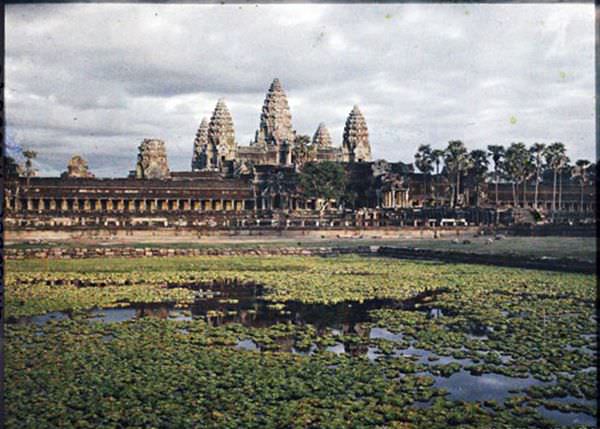
Across a broad, lily-speckled moat, the iconic towers of Angkor Wat rise in layered silhouettes, their stone spires stepping upward against a heavy, clouded sky. The foreground water plants soften the scene with a dense green texture, while the long gallery walls and colonnades stretch horizontally behind the waterline. In this colorized view labeled “Cambodia, 1900s,” the ancient temple complex feels both monumental and quietly distant, as if approached slowly from the far bank.
Color adds a different kind of immediacy to early photography, letting modern eyes read depth in the wet greens, the muted browns of weathered sandstone, and the cool gray-blue atmosphere above. The symmetry of the central sanctuary still commands attention, but the living landscape—moat, vegetation, and the thin line of trees—reminds us that this is not an isolated ruin; it sits within an ecosystem shaped by seasonal water and long human stewardship. Subtle variations in tone hint at age, erosion, and the way light drifts across carved surfaces rather than striking them sharply.
For anyone searching for “Cambodia 1900s” history, early travel photography, or Angkor Wat in the early twentieth century, this image offers more than a postcard view—it suggests how the temple was encountered before modern crowds and contemporary restoration campaigns. The distant scale makes the complex feel like a city of stone set beyond the water, inviting the viewer to imagine the approach along causeways and through darkened gateways. As a WordPress post feature, it works beautifully as a bridge between archival documentation and the renewed emotional pull that careful colorization can bring to the past.