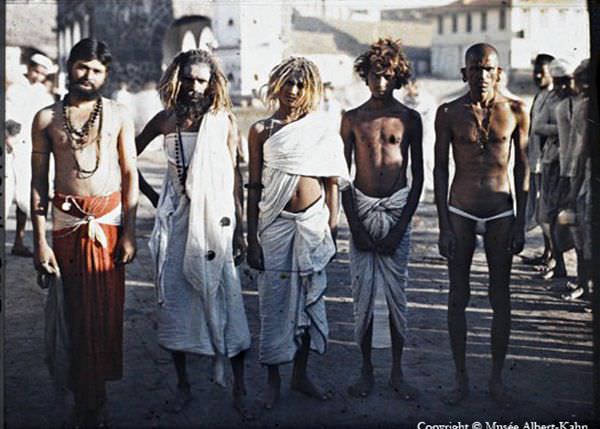
Five men stand shoulder to shoulder in a sunlit street scene from India in the 1900s, brought closer by careful colorization. Their clothing ranges from layered white drapes to a vivid red wrap at the waist, with bare chests, beads, and matted hair suggesting distinct ways of life rather than a single uniform “type.” The camera’s perspective is direct and unembellished, inviting the viewer to linger on fabric texture, posture, and expression as much as on the setting.
Behind them, a line of onlookers fades into softer focus near low buildings and an arched doorway, hinting at a busy neighborhood just outside the frame. Dusty ground, hard shadows, and the mid-day glare give the scene a lived-in immediacy that monochrome often mutes. Colorization here doesn’t merely add pigment; it emphasizes contrast—skin tones against white cloth, the warm earth underfoot, and the quiet hierarchy of who is centered versus who is watching.
Seen today, the photograph reads as both documentary and encounter, shaped by the early-20th-century fascination with cataloging people and places. Yet the men’s presence resists easy simplification: each figure carries a different stance, a different relationship to dress and adornment, and a different emotional temperature. For readers searching for a historical India photo, early 1900s street life, or vintage colorized images, this post offers a vivid portal into an everyday moment that still feels startlingly close.