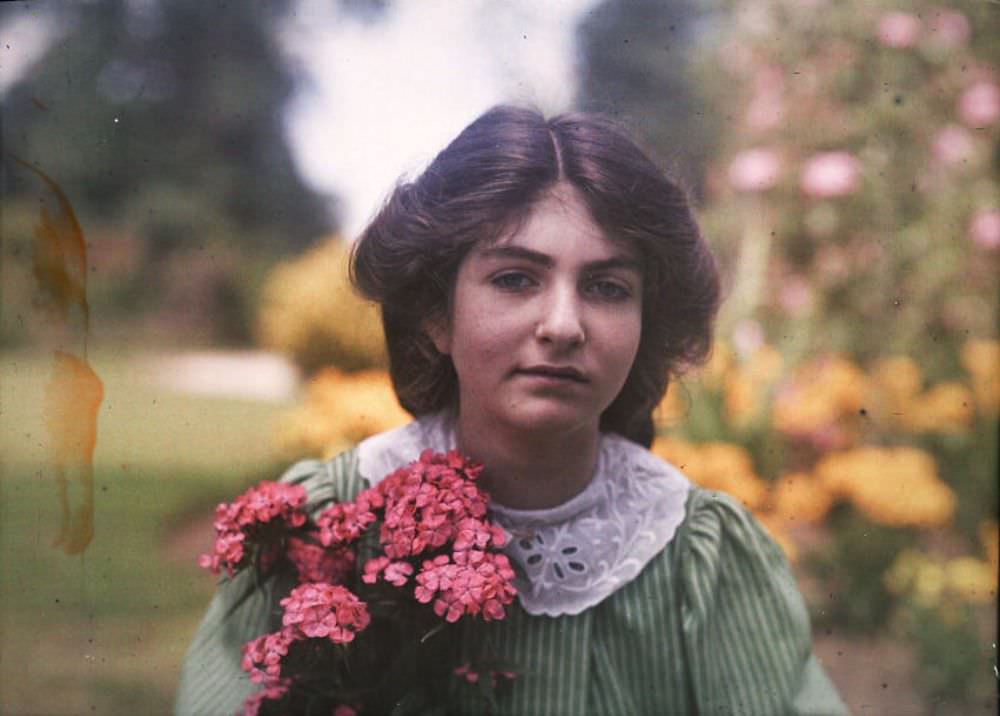
Soft garden light falls across Etheldreda Janet Laing’s daughter as she faces the camera with a calm, unguarded expression, framed by a border of summer color. Her green dress and crisp white lace collar read clearly even through the gentle haze typical of early color processes, while a tight cluster of bright pink blossoms anchors the foreground like a small offering. Behind her, flowerbeds melt into a painterly blur of golds and greens, turning the setting into a quiet stage for a personal portrait.
Autochrome photography—still a novelty in 1908—brings a particular kind of magic to scenes like this, where skin tones, fabric, and foliage appear with a soft, granular texture rather than the hard precision of later color film. That slightly dreamy look isn’t a modern “colorization” effect so much as the character of the medium itself, lending authenticity to the palette and mood. The result is an early color photograph that feels intimate and surprisingly immediate, as if the garden air and the bouquet’s scent might be just outside the frame.
For readers drawn to Edwardian-era life, family history, or the evolution of color photography, this image offers more than a pretty portrait—it hints at the domestic rituals of posing, gifting flowers, and marking time in a private outdoor space. The composition balances formality and tenderness: a centered sitter, a carefully chosen dress, and the casual closeness of the blossoms. As a historical photo, it works beautifully as a window into 1908, when gardens were both living landscapes and beloved backdrops for preserving memory in color.