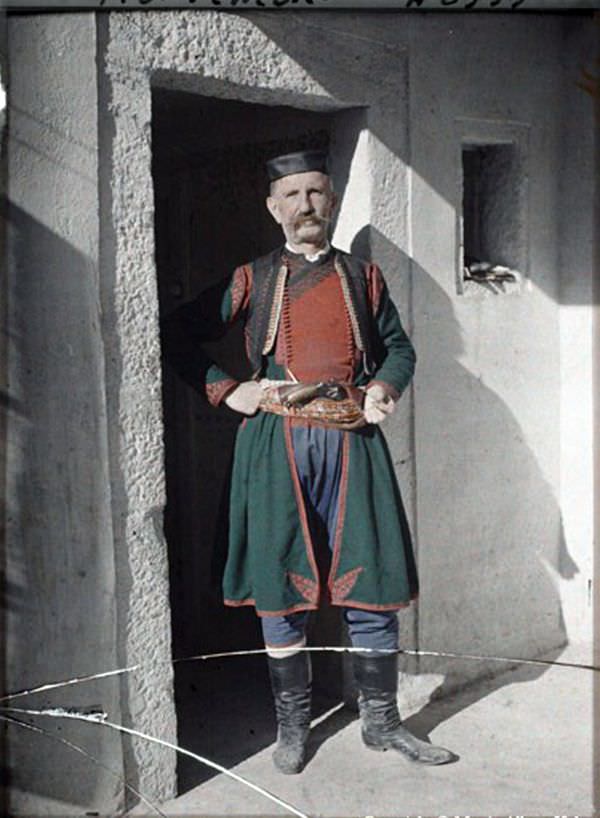
Standing in a stark doorway, a mustachioed man in traditional Montenegrin dress faces the camera with quiet authority, hands resting near an ornate belt that hints at status and everyday practicality. The colorization brings out deep greens and reds in his garments, while the soft, sunlit plaster and rough stone surround him in a world of simple architecture and strong shadows. Even without a named town or precise date, the scene speaks clearly to the early 1900s Balkans and the pride carried in regional costume.
Clothing details do much of the storytelling here: a dark cap, richly trimmed outer layers, and sturdy boots that look made for steep paths and hard ground. The belt and structured silhouette suggest more than fashion—an identity worn openly, shaped by local custom and the expectations of community life. The small window cut into the wall beside him, with a few objects tucked inside, adds a domestic note that balances the formality of his pose.
For readers searching Montenegro 1900s history, this portrait offers a vivid glimpse into how tradition, masculinity, and material culture met at the threshold of modernity. Colorized historical photos like this one don’t replace the past; they invite us closer, emphasizing texture, fabric, and the play of light that black-and-white can sometimes keep at a distance. In a single frame, the everyday doorway becomes a stage for heritage, turning a quiet moment into a lasting record of Montenegrin life.