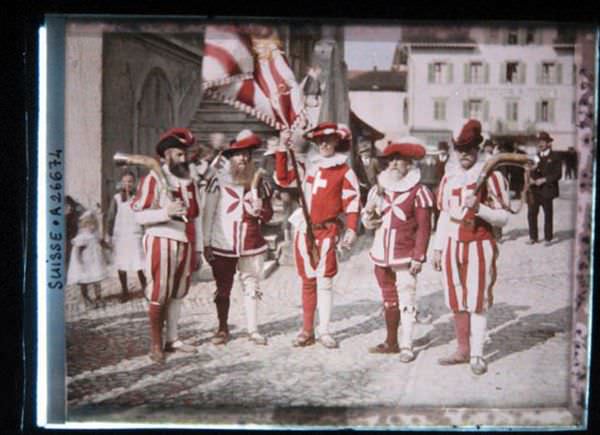
Against a cobbled street and pale plastered façades, a small troupe pauses in mid-celebration, dressed in striking red-and-white costumes that echo Swiss heraldic colors. Their outfits—striped hose, puffed sleeves, and feathered caps—suggest a ceremonial or festival role rather than everyday clothing, while the upright banners and staffs give the scene a formal, almost processional air. The careful colorization brings out the bold contrasts that early photography often muted, letting modern viewers read details that once hid in grayscale.
Off to the side, townspeople linger near the buildings, and a few figures further back drift along the road, turning this into a lived-in snapshot of a Swiss street in the 1900s rather than a studio pose. The architecture feels distinctly Central European, with sturdy masonry, arched openings, and windows set deep into the walls, hinting at a compact urban center where public squares and main streets doubled as stages for civic life. Even without a named town, the scene carries the texture of Switzerland’s local traditions—community display, costume, and pageantry woven into the rhythm of daily movement.
What makes the image especially compelling for history and genealogy enthusiasts is how it bridges performance and place: you can study fabric trims, footwear, and the way the garments hang, then compare them with regional folk dress and early-20th-century parade customs. For readers searching “Switzerland 1900s photo,” “Swiss festival costume,” or “colorized historical Switzerland,” this post offers a vivid entry point into an era when cameras were still rare enough to turn a street gathering into an event. The result is both documentation and story—a moment of pride captured on stone paving, preserved, and newly enlivened through color.