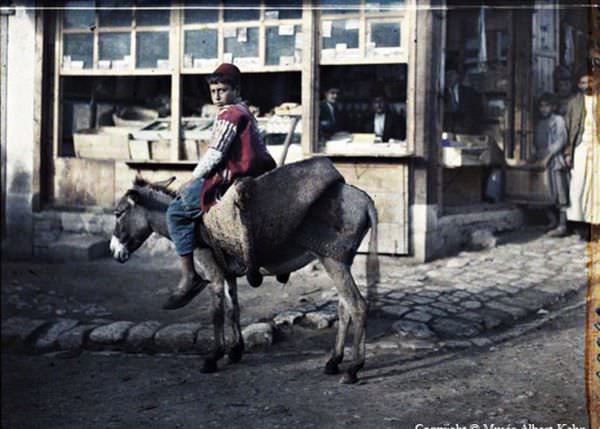
A young rider perched on a donkey moves through a cobbled street, pausing just long enough to meet the camera’s gaze. Behind him, a broad shopfront with open windows frames stacks of goods and shadowed figures, suggesting a busy marketplace in Syria during the early 1900s. The simple motion of everyday transport—animal, stone road, and bundled wares—grounds the scene in the rhythms of ordinary urban life.
Colorization adds a striking immediacy: the boy’s clothing stands out against the muted tones of the street and the donkey’s coat, while the shop interior remains dim and watchful. Details like the uneven curb stones, the worn roadway, and the varied textures of wood and plaster give the setting a tactile realism that black-and-white often softens. Even without precise identifiers, the image evokes the commercial streets where people traded, waited, watched, and passed the day.
Street photography from this period in Syria often reveals as much in the background as it does in the foreground, and here the onlookers at the right edge and within the shop hint at a wider story beyond the frame. The composition captures a moment of transition—traditional modes of travel and trade set against a storefront that feels increasingly modern in its display and openness. For readers searching for Syria 1900s history, daily life, and colorized archival photos, this scene offers a vivid window into a world both familiar and distant.