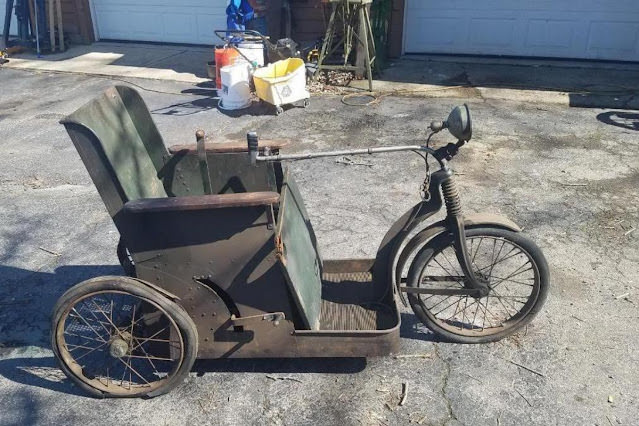
Odd little hybrids like the Custer Chair Car remind us how inventive the Roaring ’20s could be when Americans were hungry for personal mobility. Part bicycle, part wheelchair, and part scooter, the machine in the photo wears its practicality on its frame: a sturdy chair-like seat with armrests paired to a narrow front fork and a large spoked wheel, built for someone who needed stability as much as speed. Even at a glance, the design reads as an attempt to turn everyday transportation into something more accessible and independent.
From the broad rear wheels to the low step-through platform, the proportions suggest a vehicle meant to be mounted easily and kept upright without fuss. The long handlebar and compact front end hint at simple steering, while the minimal bodywork and exposed mechanical bits speak to an era when “invention” often meant making do with straightforward materials and clever geometry. Whether propelled by pedaling or a small motor in some versions, the concept fits neatly into the decade’s obsession with compact machines that promised freedom on city streets and quiet roads alike.
Set against an ordinary driveway, this surviving example feels less like a museum piece and more like a conversation starter about early adaptive transport and do-it-yourself engineering. The Custer Chair Car stands as a beacon of hope not because it was flashy, but because it aimed to widen who could travel on their own terms. For readers exploring 1920s inventions, mobility history, or the evolution of accessible vehicles, this photo offers a tangible link to an optimistic age of mechanical problem-solving.