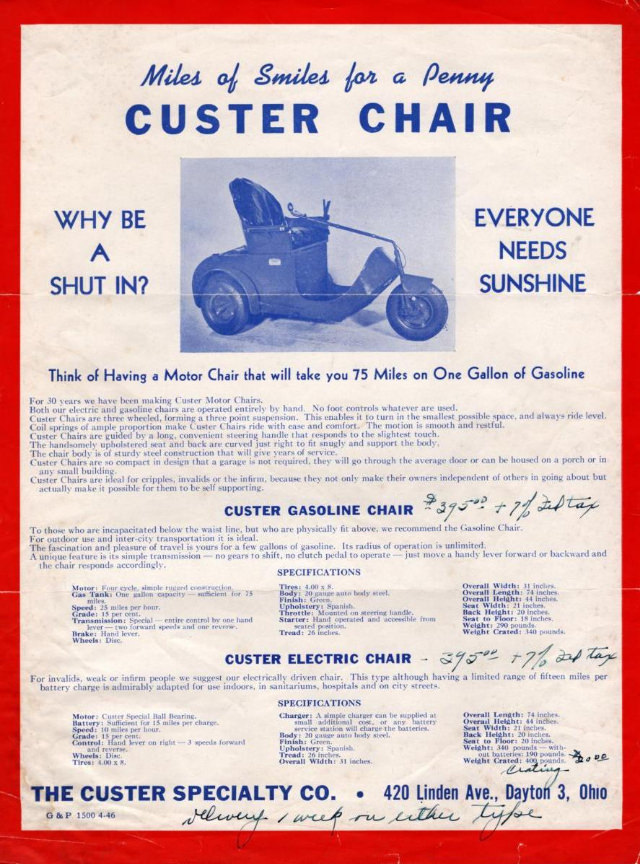
Bold advertising copy—“Miles of Smiles for a Penny”—crowns this brochure for the Custer Chair, a compact three-wheeled motor chair promoted as both practical transportation and a morale booster. At the center sits the vehicle itself, drawn like a product hero: a high-backed seat, simple controls, and a small front wheel that hints at motorcycle DNA while keeping the profile closer to a chair than a car. The layout leans on big, confident type and a friendly question—“Why be a shut in?”—aimed at readers who were being sold mobility as a form of independence.
Between the lines, the Custer Chair Car speaks to the Roaring ’20s appetite for clever inventions that promised to simplify daily life. The text touts thrift and efficiency, even claiming long miles on little fuel, while suggesting the machine could be operated without foot controls—language that points to accessibility and comfort. It’s a revealing glimpse of how manufacturers used optimism, modern engineering, and the rhetoric of sunshine to market assistive technology as an emblem of progress.
Down at the bottom, the maker’s imprint and an Ohio address anchor the piece as a real commercial artifact rather than a mere concept sketch, while handwritten notes across the page hint that someone once evaluated this promise in a practical way. For collectors, historians, and anyone interested in early mobility devices, vintage advertising, or 1920s innovation, this Custer Chair brochure offers rich detail: typography, specifications, and persuasive copy all working together to sell hope on three wheels.