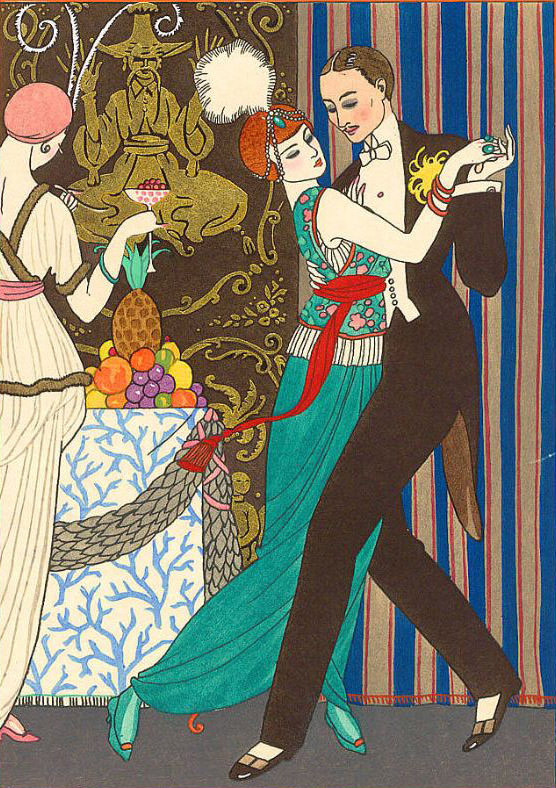
Silk-like color blocks and crisp outlines give *La danse, 1914* the polished sparkle of an early 20th-century illustration, where movement is suggested as much by geometry as by gesture. A well-dressed couple turns through a poised dance hold: his black formalwear cuts a strong diagonal, while her long teal dress flows into a sweeping hem that seems to trail the music. Her beaded headpiece and feathered accent lend a theatrical note, evoking the period’s taste for spectacle and modern elegance.
To the side, a serving figure balances a tray near a table overflowing with fruit, adding a still-life richness that contrasts with the dancers’ glide. Behind them, a decorative scene—part tapestry, part mural—unfurls in gold-toned patterns, while striped drapery frames the right edge like stage curtains. The composition reads like a soirée distilled into symbols: abundance, ornament, and the intimate choreography of social life.
Beyond its immediate charm, this 1914 artwork hints at a world captivated by fashion, performance, and the cultivated rituals of leisure. The stylized faces, flattened perspective, and boldly patterned surfaces align with the graphic sensibilities that shaped poster art and magazine illustration of the era. For readers searching for “La danse 1914,” early modern dance imagery, or decorative illustration history, the piece offers a vivid snapshot of how artists translated rhythm and romance into design.