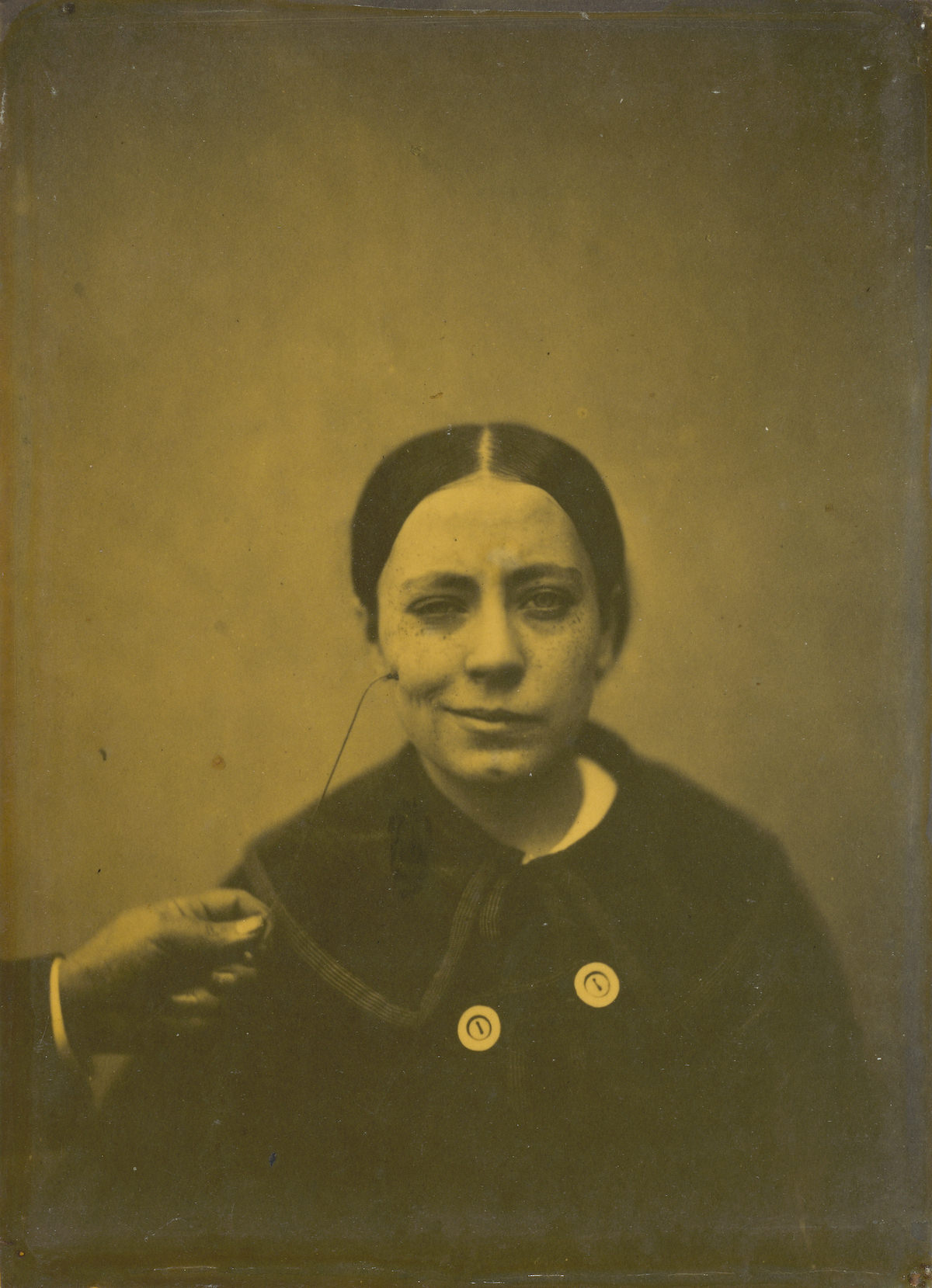
A tight, sepia-toned portrait centers on a woman with a carefully parted hairstyle and a fixed, almost practiced smile. The mouth lifts, yet the eyes stay guarded, giving “False laughter” its quiet sting—an expression that reads as performance rather than release. Her dark clothing is simple and heavy, fastened with two striking circular buttons that draw the viewer back to the composed posture of the sitter.
From the left edge, a hand enters the frame holding a thin cord or wire that arcs toward her shoulder, an odd intrusion that hints at the mechanics behind the moment. Whether it is a studio aid, a prop, or some small device meant to shape the pose, it underscores how early portrait photography often required direction, patience, and sometimes gentle coercion. The result feels less like candid emotion and more like an arranged “smile” crafted for the camera’s long attention.
“False laughter” also works as a meditation on portraiture as artwork: the tension between what a subject offers and what the lens extracts. The soft focus, the faint surface marks of age, and the stark simplicity of the background emphasize mood over setting, inviting modern viewers to search the face for sincerity. As a historical photo, it’s an SEO-friendly reminder that vintage portraits can be as revealing in their restraint as in their drama—especially when the smile doesn’t quite reach the eyes.