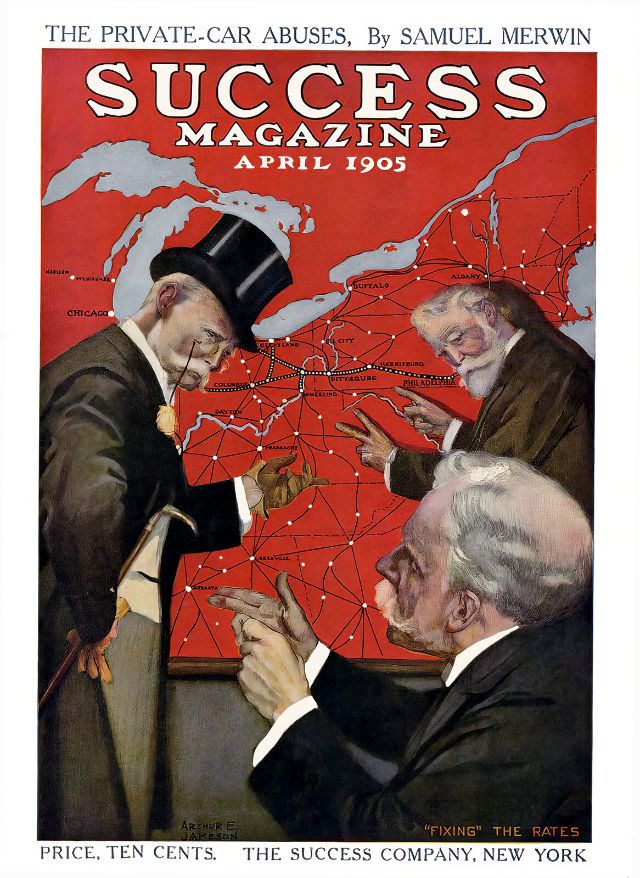
Bold red color floods the cover of *Success Magazine* for April 1905, turning a railroad map into a stage for power and persuasion. Three suited men dominate the foreground, their fingers pointed like arguments, while the Great Lakes and the northeastern United States appear behind them in a web of routes and junctions. At the top, the teaser line “THE PRIVATE-CAR ABUSES, By SAMUEL MERWIN” signals a reform-minded story, and the magazine’s confident masthead reinforces the era’s appetite for investigative journalism and modern business commentary.
The illustrated map bristles with lines and nodes, suggesting the rail network as both marvel and battlefield, where access could be negotiated, restricted, or exploited. One figure tips his hat forward with a guarded posture; another leans in as if making a case; the third gestures upward, seemingly confident of his position—together they evoke boardroom debate translated into a public spectacle. Even without reading every label, the composition makes its point: transportation, privilege, and the setting of rates are intertwined, and the stakes reach far beyond a single city.
As cover art, this piece is a vivid window into early twentieth-century magazine design, when hand-drawn illustration carried political bite and commercial polish at the same time. The bottom text—“PRICE, TEN CENTS” and “THE SUCCESS COMPANY, NEW YORK”—grounds it in the mass-market world of newsstands and serialized exposés. For collectors of antique periodicals, railroad history enthusiasts, or anyone exploring Progressive Era media, this April 1905 *Success* cover remains a striking artifact of how the public was invited to think about corporate influence and the national rail system.