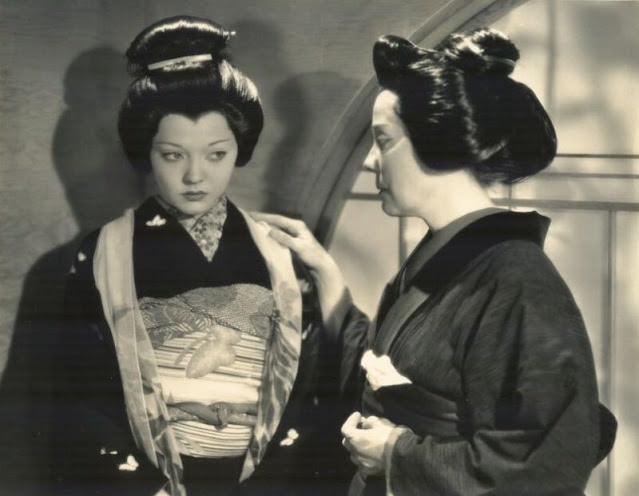
Poised beneath carefully arranged hair ornaments, Sylvia Sidney appears in full costume for “Madame Butterfly,” her gaze turned slightly away as if weighing a difficult truth. The patterned kimono and layered obi create a striking play of texture in the studio lighting, highlighting the craftsmanship that classic Hollywood leaned on to build its dramatic worlds. Even in a still moment, her expression suggests restraint, pride, and the kind of quiet tension audiences remember long after the scene ends.
Beside her, another woman in traditional dress leans in with a steadying hand on Sidney’s shoulder, an intimate gesture that reads like counsel, warning, or comfort. The framing draws attention to the space between them—close enough for trust, distant enough for uncertainty—while the soft background architecture keeps the focus on faces and posture. It’s a small tableau of relationships and expectations, the emotional currency of early 1930s cinema and its love of heightened, operatic storytelling.
Fans searching for Sylvia Sidney, Madame Butterfly 1932, or classic Movies & TV will recognize why images like this remain so shareable: they preserve mood as much as wardrobe. The photograph hints at a performance built on nuance, where a lowered eyelid or tightened mouth carries as much meaning as dialogue. Seen today, it also invites a broader look at how Hollywood interpreted stage traditions on screen, leaving modern viewers to admire the artistry while reflecting on the era’s cultural lens.