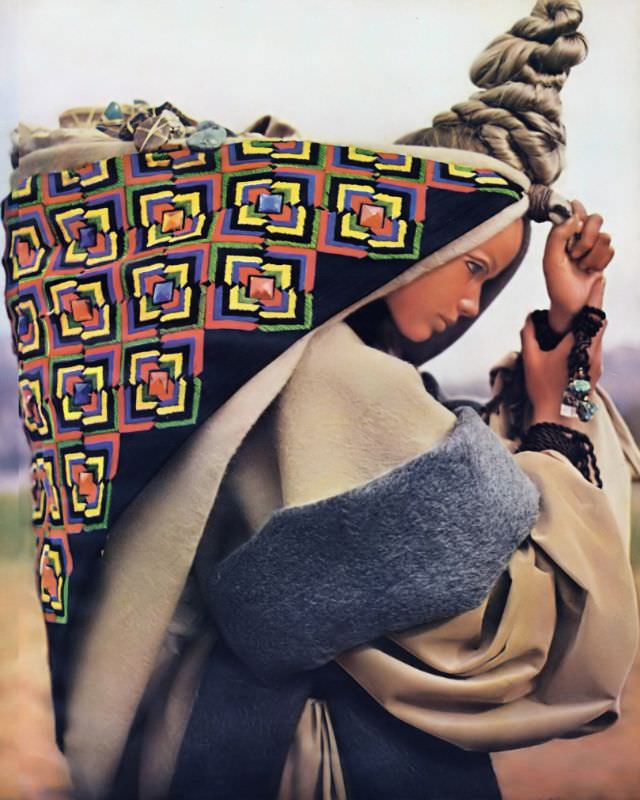
Wind seems to press against Veruschka’s profile as she leans into it, her gaze fixed beyond the frame with the cool intensity that made her a defining presence in 1960s fashion. Draped over her shoulder, Giorgio di Sant’ Angelo’s embroidery reads like a portable mosaic—bold geometric blocks of color stitched into a dark ground—turning cloth into something almost architectural. The close cropping heightens the drama: the model’s face, the curve of fabric, and the pattern’s rhythm become a single graphic statement.
Against the pale, open distance of the Painted Desert in Arizona, the styling plays with contrast—soft, sandy-toned layers and a grey wrap set off by the vivid textile, while stacked bracelets and a twisted, rope-like form above her add a tactile, handcrafted feel. There’s a sense of movement without a visible stride, as if the garment is being carried, not merely worn, and the desert air is part of the composition. The palette feels both earthy and electric, echoing the era’s fascination with folk craft, global motifs, and modernist color.
Published in Vogue in 1968, the image embodies fashion’s turn toward location storytelling, where landscape becomes collaborator rather than backdrop. The Painted Desert lends scale and myth to the editorial, situating couture-level embellishment in a rugged American terrain and letting embroidery stand in for travel, culture, and imagination. What endures is the enigma promised by the lens: a portrait that merges high fashion photography, 1960s style, and the timeless allure of the Southwest into one unforgettable frame.