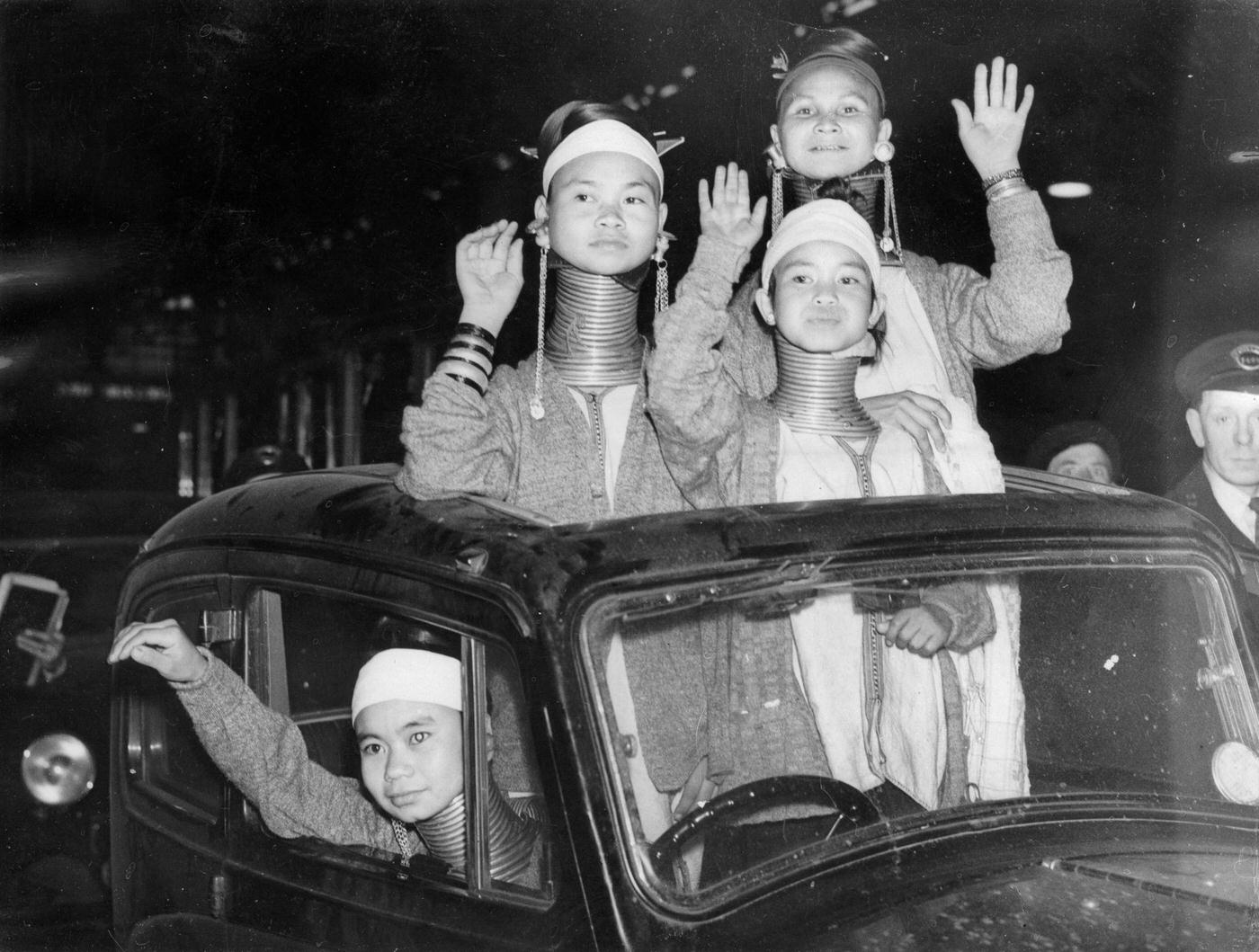
Under the harsh glow of station lights at London’s Victoria Station, four Padaung women from Burma appear poised above a car roofline, lifting their hands in greeting as if answering an unseen crowd. Their traditional headcloths frame calm, youthful faces, while the stacked metal neck rings—iconic to Kayan Lahwi identity—catch the light in bright, repeating bands. A uniformed figure at the edge of the frame and blurred onlookers in the background hint at the public attention that followed them.
The photograph balances warmth and spectacle: smiles and waves on one side, the unmistakable emphasis on “neck rings” on the other, inviting viewers to consider how fashion, culture, and curiosity collided in interwar Britain. Heavy bracelets, layered textiles, and the careful arrangement of jewelry stand out against the dark, busy station interior, turning a transit moment into a staged arrival. Even without hearing the surrounding voices, the scene suggests the hum of metropolitan travel—platforms, passengers, and the press—focused briefly on these visitors.
Titled “Four Padaung women from Burma at Victoria Station, London, April 1936,” the image serves as a vivid record of cross-cultural encounter in the era of empire, when people were frequently presented abroad through the lens of exotic display. It preserves details valuable to historians and readers searching for Kayan Lahwi/Padaung tradition, neck ring practice, and 1930s London street life: the car, the crowd, the clothing, and the gestures of introduction. More than a curiosity, it is a snapshot of how identities were seen, curated, and remembered as they moved through a world of railways and headlines.