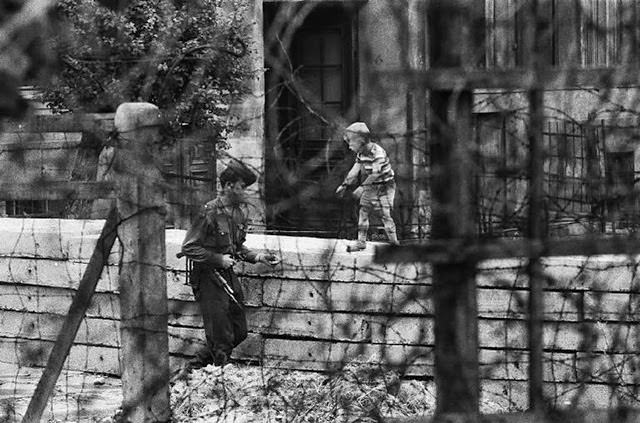
Barbed wire cuts across the foreground like a scribble of danger, yet beyond it a small scene unfolds with disarming ease: a boy balances along a low concrete barrier while an East German border guard stands close by, rifle at his side. The child’s posture suggests play—testing footing, reaching out, absorbed in the simple challenge of movement—while the soldier’s presence anchors the moment in the reality of the Berlin border wall. Set against plain building facades and hard edges, the contrast between childhood spontaneity and state security feels almost surreal.
Along the border between East and West Berlin, fences were not just barriers of steel and concrete; they were instruments of ideology, surveillance, and control. Here, the tangle of wire and posts frames the pair as if the viewer is looking through a cage, reminding us how ordinary life was forced to negotiate extraordinary restrictions. The guard’s uniform and weapon speak to the Cold War’s constant tension, but the boy’s curiosity hints at how people—especially children—found ways to exist within, around, and despite the enforced division.
Moments like this resonate far beyond Berlin’s history because they show the human scale of political conflict. The photo invites questions that still drive searches for Berlin Wall history, East German border guards, and daily life in divided Germany: What counted as normal when separation was institutionalized? The answer often lies in small, fleeting encounters like this one, where play and patrol share the same narrow strip of ground behind a barbed wire fence.