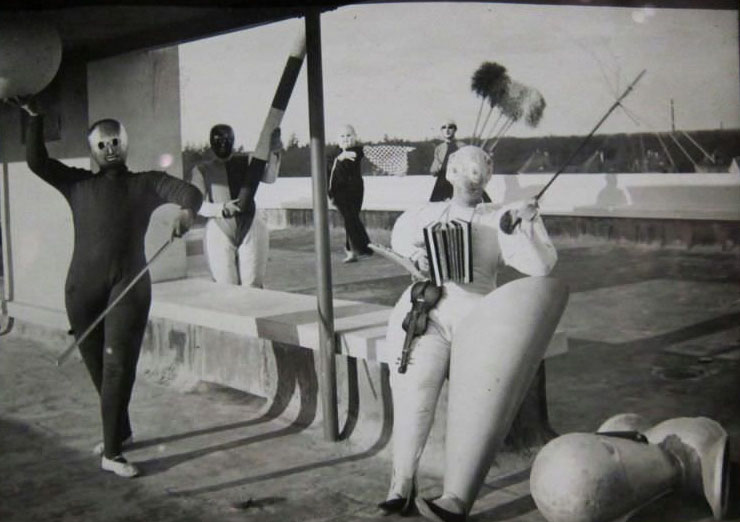
Stark masks and sculptural costumes turn the dancers into living geometry, their bodies reduced to spheres, cylinders, and gleaming surfaces that feel more engineered than sewn. One figure carries an accordion-like instrument while another lifts an arm in a poised, mannequin-like gesture, as if movement itself has been rebuilt from simple shapes. The effect is uncanny and playful at once—part stage spectacle, part avant‑garde experiment in what a human silhouette can become.
Along the open terrace-like setting, the performers stand and pose with props that read as both musical and mechanical, blurring the line between dance, fashion design, and modern industrial aesthetics. The oversized rounded suit in the foreground dominates the frame, making the costume the true protagonist and pushing individuality into the background. Even in grayscale, the scene suggests a bold visual language associated with Roaring Twenties culture: modernity, abstraction, and the thrill of breaking from tradition.
Behind the surreal humor lies a serious artistic idea—choreography as a dialogue between the body and design, where fabric, padding, and hard forms dictate how a dancer can move. The Triadic Ballet has long been linked to early modern performance and experimental theater, and this photo conveys why: it looks like a blueprint for a new kind of stage art. For anyone searching the history of avant‑garde dance, Bauhaus-era style, or 1920s fashion and culture, the image offers a memorable glimpse of costumes that transformed performers into animated sculptures.