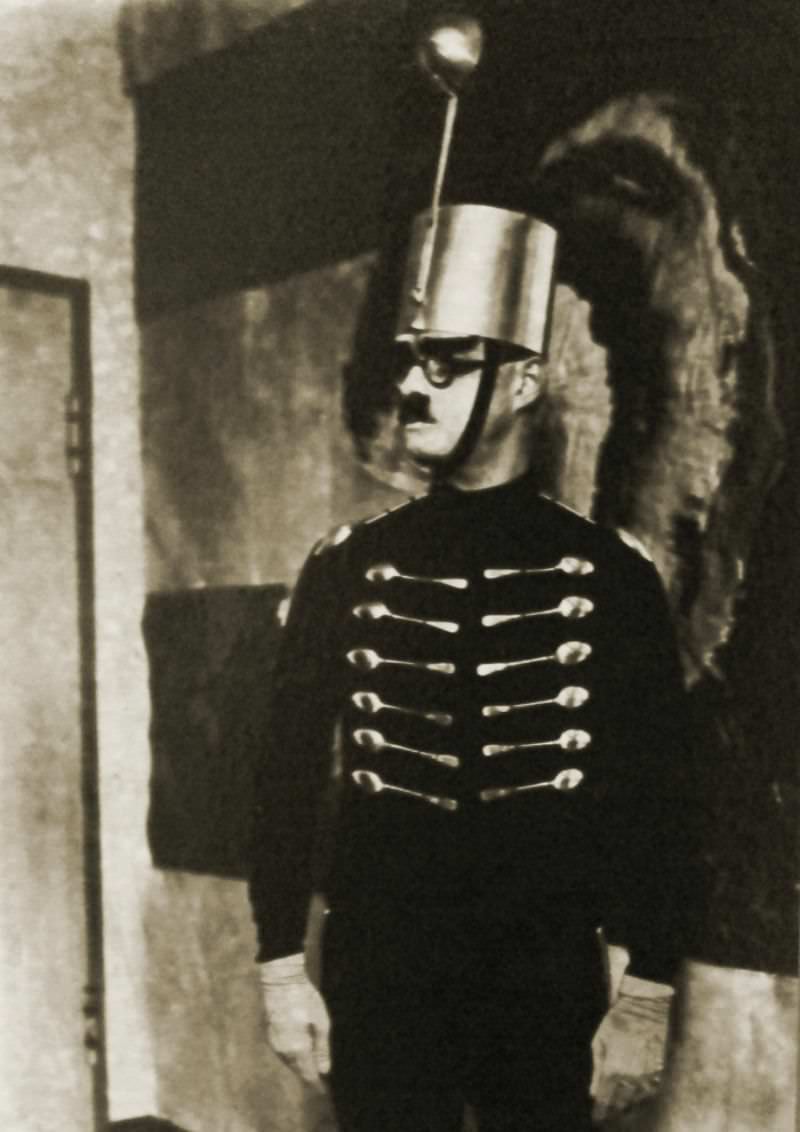
A lone performer stands in profile, half swallowed by shadow, wearing a costume that turns the body into a graphic design. A tall metallic cylinder crowns the head like an industrial top hat, while a dark tunic is laced with bright, symmetrical fastenings that read almost like ribs or musical notes. The face appears masked or stylized, giving the figure a mannequin-like calm that suits the title’s promise of surreal stagecraft.
Behind him, the setting feels more like a backstage corner than a polished theatre—rough surfaces, indistinct shapes, and the sense of a prop room hovering just out of frame. That contrast heightens the uncanny effect: futuristic headgear and regimented ornamentation set against an ordinary, worn backdrop. Even without motion, the costume implies choreography, as if a single step would set the geometric silhouette into a measured, mechanical dance.
In the context of Roaring Twenties fashion and culture, the image echoes the era’s fascination with modernity—machines, new materials, and avant-garde performance experiments that blurred fine art, design, and ballet. The Triadic Ballet is evoked here not through elaborate scenery but through the disciplined abstraction of the outfit, where costume becomes architecture and the dancer becomes a moving form. For historians of theatre, modernist costume design, and early twentieth-century visual culture, it’s a striking reminder of how radical stage fashion could be when artists let geometry lead the body.