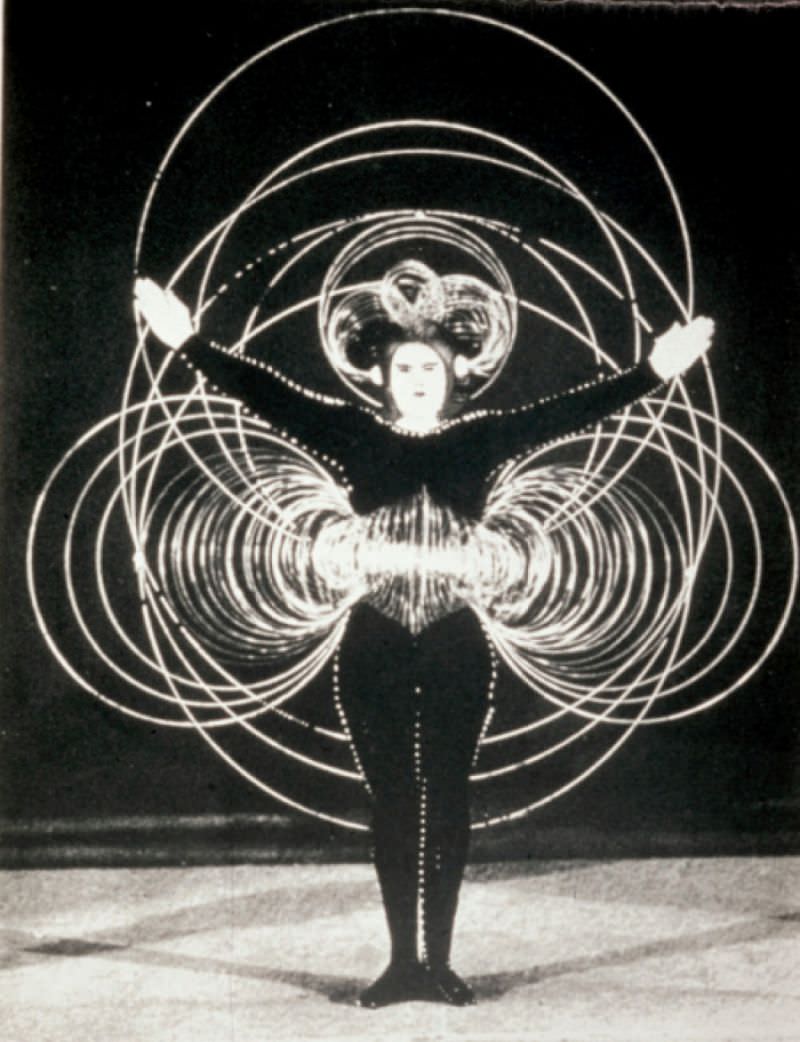
Against a dark stage, a lone dancer stands with arms thrown wide, turning the human figure into a compass point for pure geometry. Bright, looping arcs—like drawn light or polished wire—flare outward in layered circles, forming a haloed architecture around the body. The costume reads as modern and theatrical at once: a sleek, fitted silhouette punctuated by a line of glinting accents, while an ornate, sculptural headpiece frames the face with near-mechanical symmetry.
The effect is unmistakably in the spirit of the Triadic Ballet, where fashion and performance collide to produce a surreal, almost engineered kind of beauty. Here the dancer seems less like an individual and more like a moving diagram, animating concentric patterns that suggest orbit, rhythm, and measured repetition. Even in a single still moment, the photograph implies motion—spins, sweeps, and calculated poses—echoing the Roaring Twenties fascination with speed, machines, and avant-garde design.
What makes this image so enduring for cultural history and SEO searches alike is its fusion of early modern dance, experimental costume, and abstract stagecraft. The geometric shapes are not mere decoration; they act as visual choreography, turning space into a partner and the performer into a living sculpture. As a document of 1920s fashion & culture, it hints at a world where art sought new languages—built from circles, lines, and daring imagination—long before “futuristic” became a marketing term.