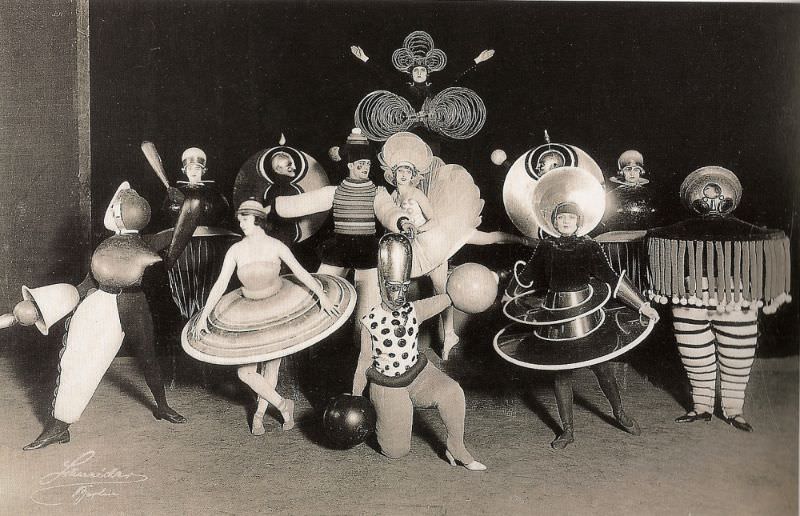
A stage crowded with uncanny silhouettes opens onto the playful radicalism of the Triadic Ballet, where dancers appear less like flesh-and-blood performers than animated sculptures. Bulbous headpieces, spherical helmets, and layered hoops turn bodies into walking geometry, while the dark backdrop isolates each figure like a living diagram. The pose feels midway between curtain call and laboratory demonstration—an ensemble arranged to let the audience read the shapes as clearly as the choreography.
At the center, a performer in a wide circular tutu-like construct seems to spin in place, while nearby others stand encased in concentric rings, striped cylinders, and padded forms that exaggerate hips, shoulders, and torsos. Faces peek out from porthole-like openings, reminding viewers that humans are inside these costumes even as the designs push them toward abstraction. The overall effect is both whimsical and mechanical, echoing the era’s fascination with modern design, industrial materials, and the promise of a new visual language for dance.
Within the broader world of Roaring Twenties fashion and culture, this surreal ballet reads as a manifesto in motion: costume as architecture, performance as avant-garde art. The geometric wardrobe blurs boundaries between theater, sculpture, and experimental design, anticipating later trends in stagecraft and conceptual costuming. Seen today, the photograph remains a vivid snapshot of modernism’s appetite for transformation—turning performers into planets, toys, and machines, all at once.