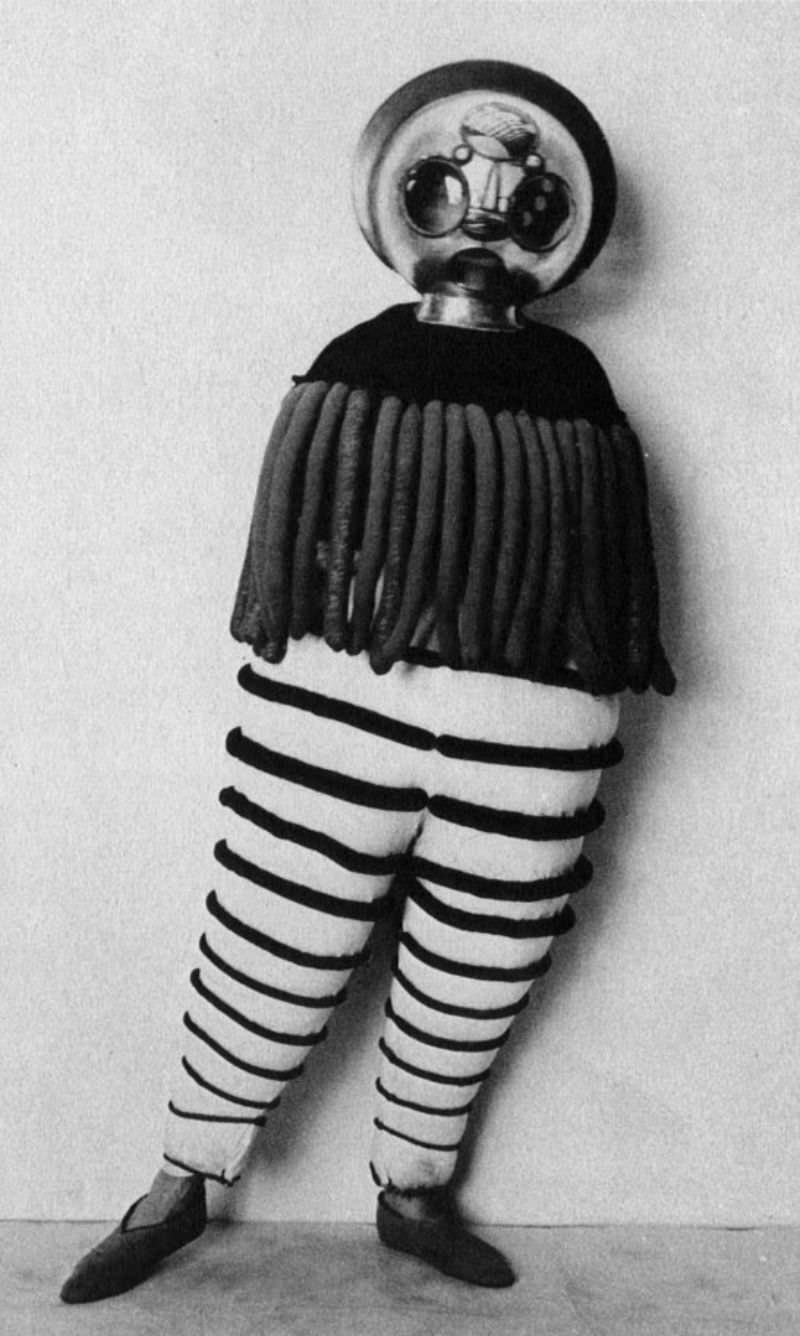
A lone dancer stands against a bare wall, transformed into a playful machine of circles, bands, and padded volume. The head becomes a glossy, helmet-like disk with round protrusions that read like oversized lenses, while the torso swells into a ribbed, skirted form that exaggerates the body into a near-cartoon silhouette. Below, tight horizontal stripes march down the legs, turning movement into a kind of optical rhythm, finished with simple dark shoes that anchor the figure on a plain studio floor.
In the spirit of the Triadic Ballet and its Roaring Twenties fascination with geometry, this costume treats fashion as architecture and choreography as design. Soft materials mimic hard forms, suggesting spheres and cylinders without losing the sense of fabric and handcraft, and the overall effect is deliberately surreal—half human performer, half animated sculpture. With the face obscured and the body abstracted, identity gives way to pattern, proportion, and the strange humor of modernism.
Such images sit at the crossroads of avant-garde theater, early twentieth-century costume design, and experimental dance, where the stage became a laboratory for new ideas about the body. The stark background and straightforward photographic framing keep attention on the silhouette, inviting viewers to imagine how these geometric shapes would pivot, sway, and clatter through a performance. For anyone searching fashion history, Bauhaus-era aesthetics, or 1920s modernist culture, the photograph offers a memorable emblem of how radical design once stepped—literally—into motion.