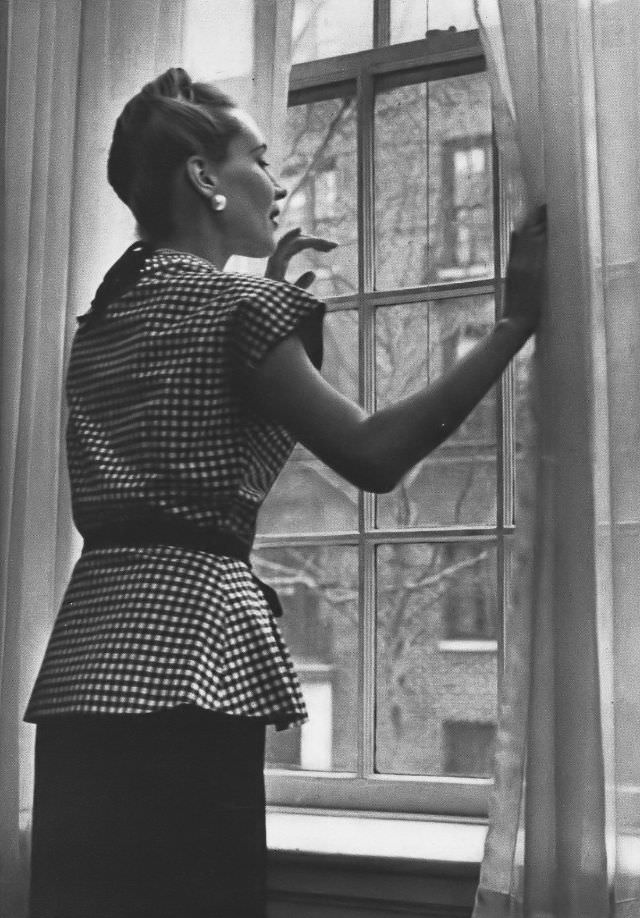
Poised in profile beside a tall-paned window, a model lifts one hand toward the glass while the other gathers a sheer curtain, turning a quiet interior into a stage for mid-century style. Soft daylight skims her cheek and earrings, outlining a sleek updo and the composed, slightly distant expression that fashion editors prized for elegance. Beyond the window, faint building façades and bare branches create an urban backdrop that keeps the focus firmly on silhouette and texture.
The outfit marries crisp pattern with clean lines: a black-and-white checked gingham top shaped with a ripple peplum, cinched at the waist before flaring neatly over a straight black rayon skirt. That contrast—busy checks above, smooth dark fabric below—reads as practical sophistication, a look that could move from department-store display to magazine page without losing its polish. Even in monochrome, the interplay of weave, drape, and structure conveys the era’s fascination with controlled femininity and modern ease.
Set in the orbit of Bloomingdale’s and the editorial world of Vogue in 1945, the scene speaks to how retail and publishing helped define postwar taste. The composition favors narrative over spectacle: a woman framed by window light, caught between interior refinement and the city outside, suggesting aspiration as much as apparel. As a piece of 1940s fashion photography, it preserves the moment when gingham, peplums, and rayon became shorthand for chic, accessible glamour in American style culture.