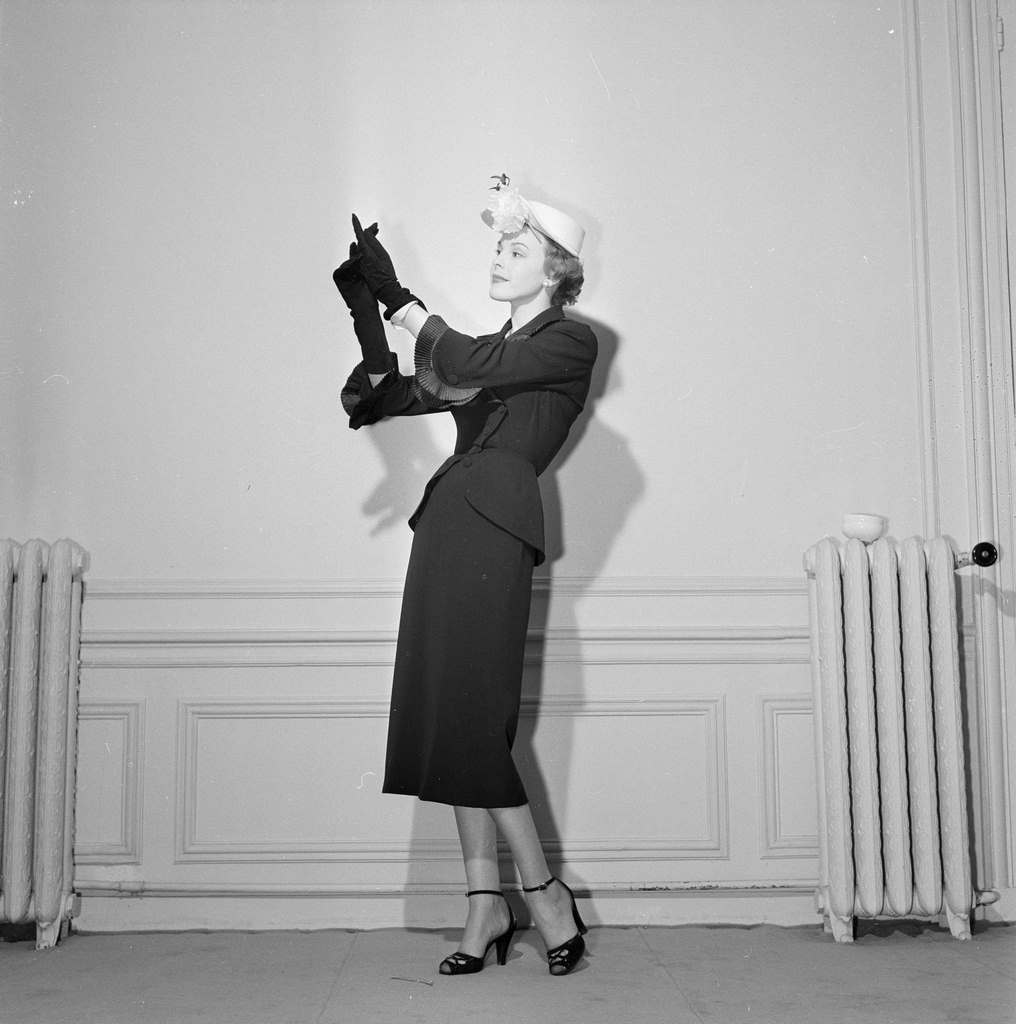
Poised against a bare wall, a model performs a small drama of gesture: arms lifted, gloved hands angled upward, chin turned as if addressing an unseen audience. The outfit reads as classic early‑1950s couture tailoring—nipped waist, sculpted hips, and a clean, pencil‑slim skirt that falls to mid‑calf—balanced by a neat, tilted hat with delicate trim. Even the stark studio setting, with radiators and molding left plainly visible, amplifies the silhouette and the careful play of shadow.
Spring 1951, as suggested by the title “Fashion Collection of ‘Couturiers Associés,’” evokes a moment when Paris fashion promoted collective prestige alongside the signatures of individual houses. Here the emphasis is on line and control: strong shoulders, a crisp jacket front, and long, dark gloves that add theatrical elegance without distracting from the cut. The strappy heels and restrained accessories underline a look designed for confident public appearance—daytime sophistication with evening polish close at hand.
Beyond a single ensemble, the photograph functions as a compact record of postwar style culture, when couture was marketed through posed studio images that could travel in magazines and press packets. The minimal background keeps attention on craftsmanship—how fabric, fit, and posture work together to communicate status and modern femininity. For anyone searching mid‑century fashion history, Paris couture, or Spring 1951 runway and showroom imagery, this scene offers a clear, memorable example of the era’s disciplined glamour.