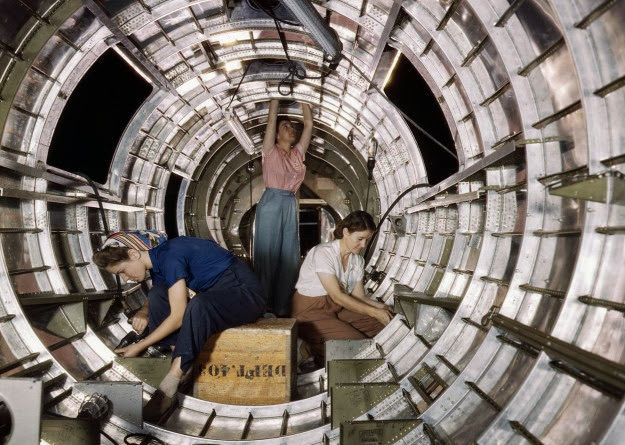
Inside the skeletal tail fuselage of a B‑17F bomber, three women at Douglas Aircraft Company in Long Beach, California, concentrate on the unglamorous essentials of wartime production. Curved ribs and stringers form a tunnel of bare metal, punctuated by oval openings and brackets waiting to be filled, while a tangle of wiring and hardware hints at the complex systems that would soon run through this airframe. The colorization emphasizes the industrial palette—cool aluminum, work clothes, and the warm wood of a crate—making the scene feel immediate rather than distant.
Their tasks are small in scale but decisive in consequence: installing fixtures, fastening components, and fitting parts into a space that seems barely wide enough to turn around in. One worker reaches upward toward the overhead structure, another leans into a compartment with tools and fasteners, and a third sits close to the frame where the aircraft’s internal anatomy is most visible. In a single view, the photograph conveys the precision of aircraft assembly, where repetitive handwork and careful alignment transform a hollow shell into a functioning military machine.
For readers searching WWII home front history, women in aviation manufacturing, or Douglas Aircraft Company Long Beach 1942, this image offers a grounded look at how the “Flying Fortress” was built long before it ever left the runway. The focus isn’t on ceremony or heroics, but on skilled labor carried out in tight quarters, under the pressure of wartime demand and factory schedules. As a colorized historical photo, it bridges memory and material detail, inviting a closer reading of the everyday craftsmanship that sustained Allied air power.