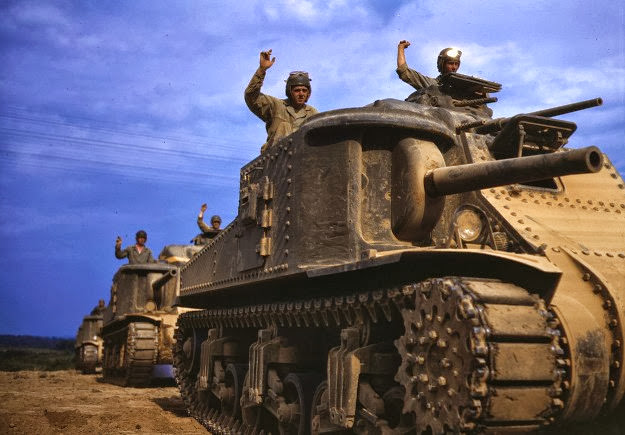
Dust hangs low over the training ground at Fort Knox, Kentucky, as a column of M-3 tanks rumbles forward under a wide, cloud-streaked sky. The lead vehicle dominates the frame—riveted armor plates, heavy tracks, and the distinct sponson-mounted gun marking the early-war silhouette of the M3 Lee/Grant family. Tankers ride high in the open hatches, arms raised in a casual wave that feels both confident and candid amid the machinery.
Set in 1942, the scene speaks to a United States Army rapidly expanding its armored forces and turning Fort Knox into a proving ground for crews and equipment. The colorization brings out the sandy tones of the vehicles and the deep blues overhead, helping modern viewers read details that often disappear in monochrome: grime on the hull, metal edges worn bright, and the practical uniforms of the men inside. It’s a reminder that military history is made as much in repetitive training runs and shared moments as in headlines.
For anyone searching WWII armor, Fort Knox tank training, or the M-3 medium tank in American service, this photo offers an immediate, close-up look at how these vehicles appeared and operated in the field. The camera’s low angle emphasizes mass and momentum, while the line of following tanks hints at scale—multiple crews learning the same routines, building coordination one mile of track at a time. Seen today, the image becomes a vivid postcard from the era when U.S. armored doctrine was being forged in motion.