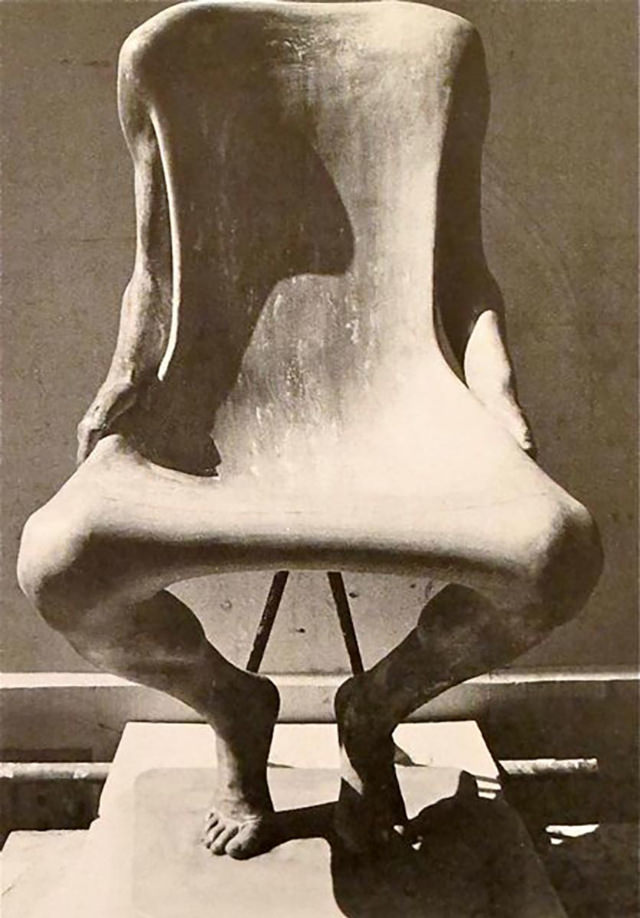
A seated nude figure is seen from behind, posed with knees wide and feet planted, turning the human back and hips into a bold, almost architectural silhouette. The composition is spare—just a platform beneath the subject and a plain backdrop—so attention falls on curvature, weight, and balance. Light slides across the body’s surface like it would across polished wood or molded plastic, hinting at the image’s fascination with form over identity.
Ruth Francken’s Homme Chair enters that space between sculpture and furniture, where the body isn’t merely depicted but translated into an object you could imagine inhabiting a room. In the photo, the sitter’s posture reads like a prototype: the “seat” seems to be the body itself, while the torso rises like a backrest, making anatomy feel engineered. That tension—between intimacy and design—helps explain why the Homme Chair remains a provocative touchstone in conversations about modern art, invention, and the history of functional sculpture.
For readers drawn to design history and avant-garde interiors, this post traces how a daring concept became an emblem of its era’s appetite for boundary-breaking objects. The image invites close looking: the exaggerated negative spaces, the strong shadow under the platform, and the way the pose transforms flesh into contour and volume. As a piece of visual storytelling, it’s a striking reminder that innovation sometimes begins with simply seeing the familiar—like a model’s backside—through the lens of art.