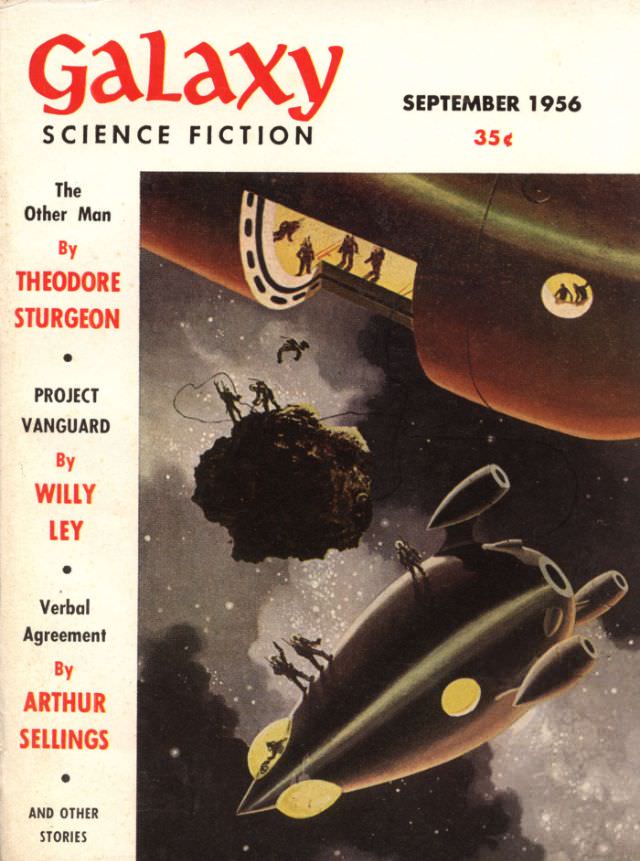
Bold red lettering announces *Galaxy Science Fiction* while “September 1956” and the 35¢ price sit crisply at the top, anchoring the cover in mid-century magazine culture. Down the left margin, the contents tease readers with prominent bylines—Theodore Sturgeon, Willy Ley, and Arthur Sellings among them—hinting at the mix of imaginative storytelling and science-minded speculation that defined the title. Even before a page is turned, the typography and layout sell the era’s confidence in the future.
Across the main illustration, sleek spacecraft glide through a smoky starfield, their rounded hulls rendered in warm metallic tones that feel distinctly 1950s. Tiny figures appear mid-action: some clustered in a lit windowed section, others drifting or working near a rough, tumbling asteroid-like mass, suggesting peril, salvage, or an off-world rescue. Yellow portholes and thruster details punctuate the composition, drawing the eye along the diagonal motion and giving the scene a cinematic sense of speed and scale.
As a piece of pulp magazine cover art, this *Galaxy* issue distills the Cold War space-age imagination into one dramatic tableau—technology, danger, and human daring set against the vast unknown. It’s an appealing artifact for collectors of vintage science fiction, readers tracing the visual history of space travel in popular media, or anyone interested in 1950s illustration techniques. The result is both a striking graphic design and a time capsule of how tomorrow looked from 1956.