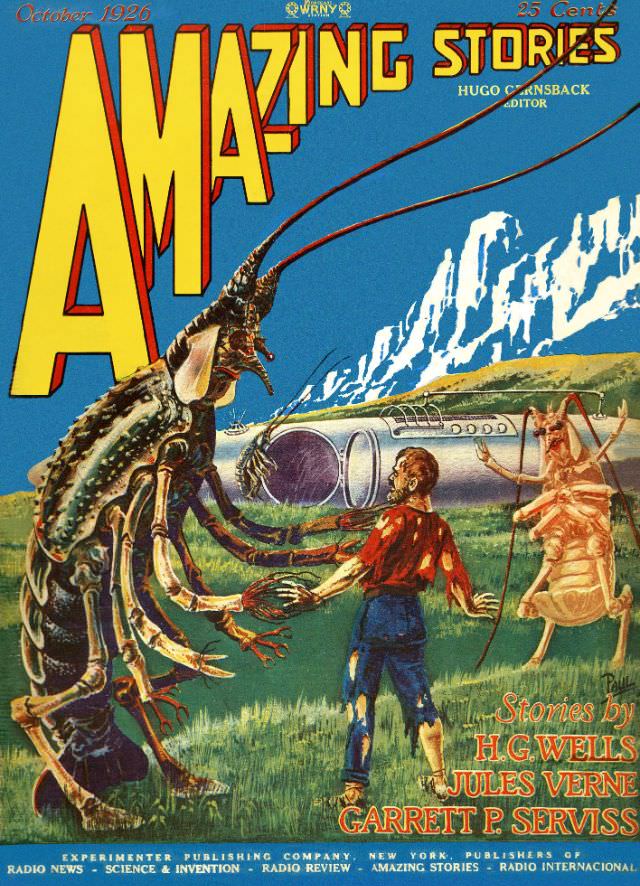
Bold block lettering shouts “AMAZING STORIES” across a saturated sky-blue field, instantly evoking the exuberant design language of early science fiction magazines. The cover is clearly marked October 1926, with “Hugo Gernsback” credited as editor and the price set at 25 cents—small details that anchor the artwork in the era when pulp publications were shaping public dreams of technology and tomorrow.
Center stage, a tense standoff unfolds on an open green plain beneath jagged white mountains: an insect-like creature with long antennae and segmented limbs reaches toward a startled man, while another figure gestures urgently in the background. A sleek, cylindrical machine—part rocket, part experimental craft—rests nearby, its metallic sheen and round windows suggesting travel beyond ordinary frontiers and the kind of mechanical wonder readers expected from the magazine’s pages.
At the lower right, the promise of famous speculative fiction is used as a hook, with “Stories by H.G. Wells, Jules Verne, Garrett P. Serviss” printed prominently. For collectors, historians, and fans of pulp cover art, this issue is a vivid snapshot of how 1920s popular culture imagined alien encounters and scientific marvels—equal parts adventure, anxiety, and bright-eyed curiosity, all packaged to grab attention on a newsstand.