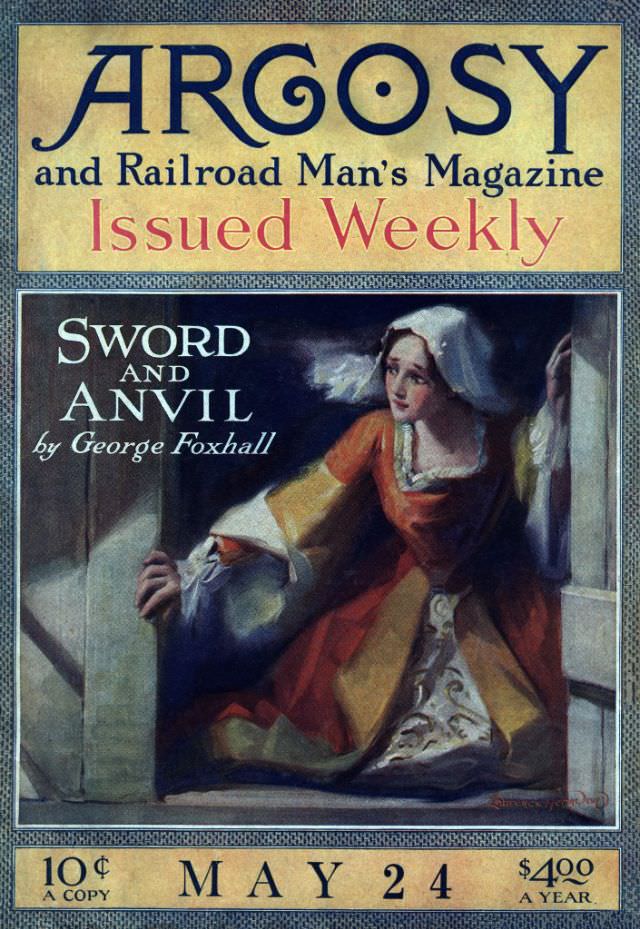
Bold typography announces “ARGOSY and Railroad Man’s Magazine” across the top of this May 24, 1919 cover, a reminder of how newsstand periodicals competed for attention with oversized lettering and confident branding. The promise “Issued Weekly” sits prominently beneath the masthead, while period pricing—10¢ a copy and $4.00 a year—anchors the artwork in the everyday economics of early twentieth-century reading.
Down in the main illustration, drama takes over: a bonneted woman in warm reds and golds appears caught mid-flight, framed by shadowy architecture that suggests a doorway or stairwell. The composition leans into suspense, pairing soft, painterly highlights with deep blues and blacks to heighten tension and motion, the sort of pulp-era storytelling meant to be understood at a glance from across a crowded magazine rack.
Text on the cover advertises the featured tale, “Sword and Anvil,” credited to George Foxhall, blending literary promotion with cinematic imagery in a single, efficient design. For collectors of Argosy magazine covers, pulp art enthusiasts, and anyone researching popular culture after World War I, this piece offers a vivid snapshot of how illustration, typography, and serialized fiction worked together to sell adventure week after week.