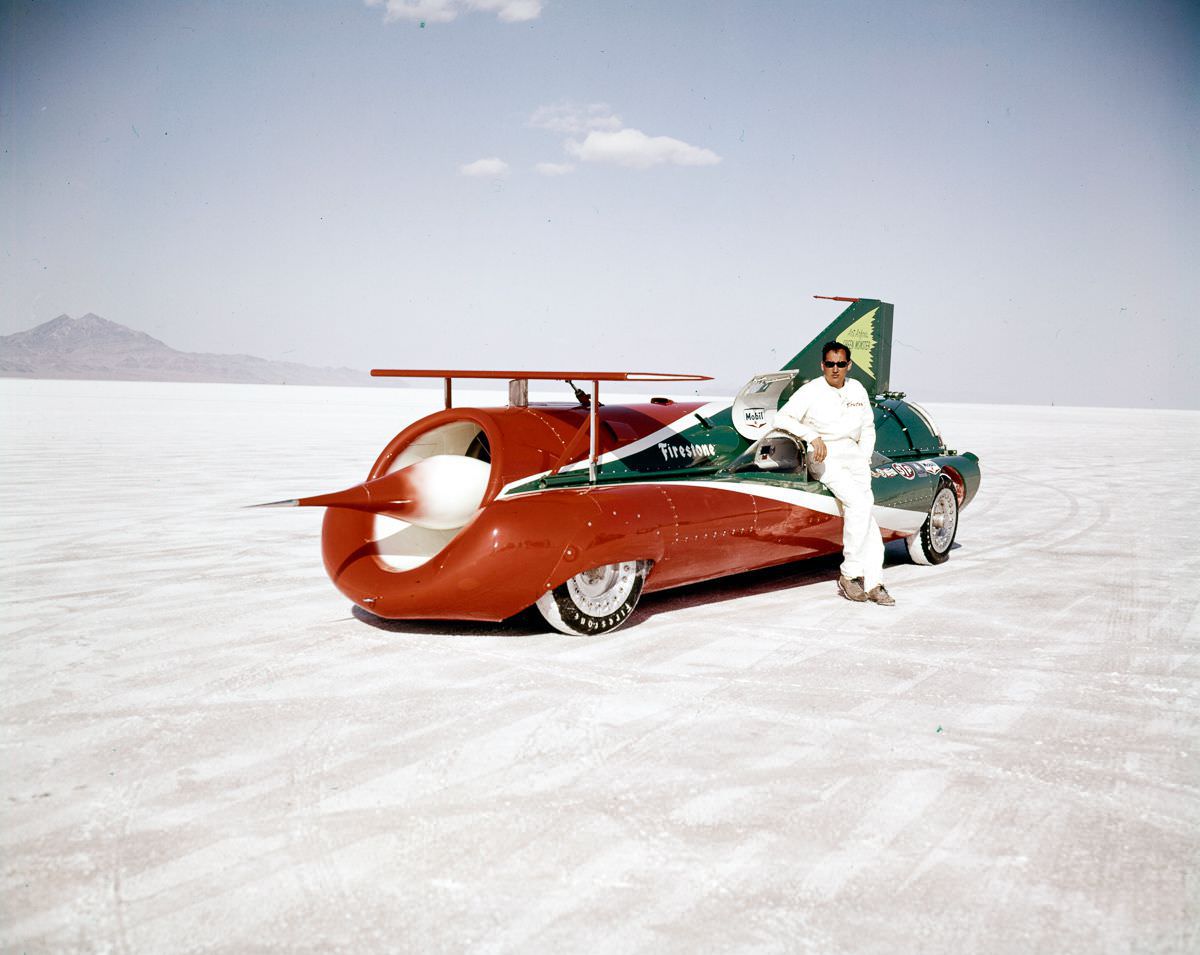
Under a wide, pale sky on the Bonneville Salt Flats, Art Arfons poses with the jet-propelled “Green Monster,” its needle-nosed body stretched low against the blinding white crust. The machine’s bold green-and-red paint and towering fin contrast sharply with the empty horizon, turning the still moment into a billboard for speed. Sponsor markings and racing tires hint at the practical reality behind the spectacle: this was engineered for a single purpose—straight-line velocity.
Arfons, dressed in white and leaning calmly at the cockpit area, gives the scene a human scale that makes the car’s proportions feel even more extreme. The long stabilizing wing and streamlined intake shapes read like aviation translated onto wheels, a reminder of how mid-century land speed racing borrowed ideas from jets and rockets. Even at rest, the “Green Monster” looks poised to break the silence, as if the salt itself were a runway waiting for takeoff.
Stories from Bonneville are often told in numbers—records, miles per hour, and mechanical limits—but photographs like this preserve the atmosphere of the speed trials: heat haze, distance, and determination. With the flats stretching uninterrupted to the mountains, the setting emphasizes why Bonneville became a proving ground for innovators and daredevils alike. For readers exploring land speed record history, this image captures the era’s blend of showmanship and engineering that made the Green Monster an icon of motorsport ambition.