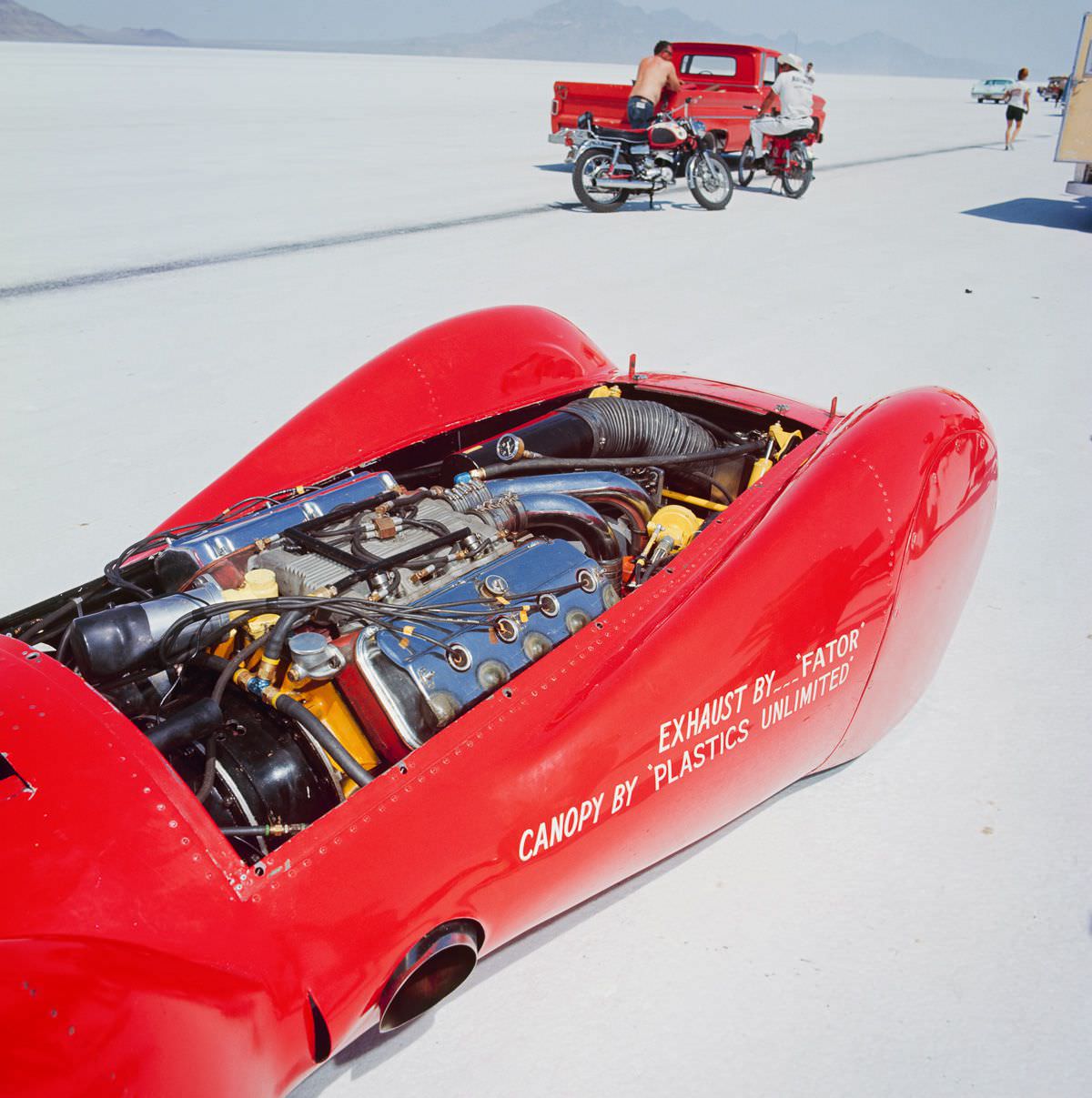
Sunlight bounces off the endless white of the Bonneville Salt Flats as the Hammon-McGrath-Appenfels “Redhead” rests for a moment, its smooth red bodywork opened up to reveal the machinery that made land-speed dreams plausible. With the engine cowling removed, the streamlined racer stops being a mysterious bullet and becomes a workshop on the salt—rivets, ducts, and polished hardware laid bare against a horizon that feels almost empty on purpose. Even the small background details—support vehicles and onlookers—hint at the improvised, communal bustle that always surrounds serious speed attempts.
Up front, the exposed supercharged Hemi powerplant dominates the frame, a dense cluster of lines, fittings, and metal surfaces designed to survive long full-throttle runs. The cutaway view emphasizes how land speed racing is as much about packaging and airflow as raw horsepower, with the intake plumbing and tight clearances tucked inside a body shaped for minimal drag. Painted lettering along the side adds period authenticity and a sponsor-driven practicality, reminding readers that record chasing often relied on specialized parts, small businesses, and ingenuity as much as factory muscle.
Alongside the existing theme of “Speeding to Glory,” this photo is a vivid window into the Bonneville Salt Flats Speed Trials era, when American hot-rodding culture met aerospace-like thinking on a natural test track. The “Redhead” embodies that blend: a sleek shell meant to slip through air, and a visible engine bay that celebrates mechanical audacity rather than hiding it. For enthusiasts searching for Bonneville history, land speed racing technology, or supercharged Hemi engineering, the image captures the moment before motion—when everything is checked, exposed, and poised for the run.