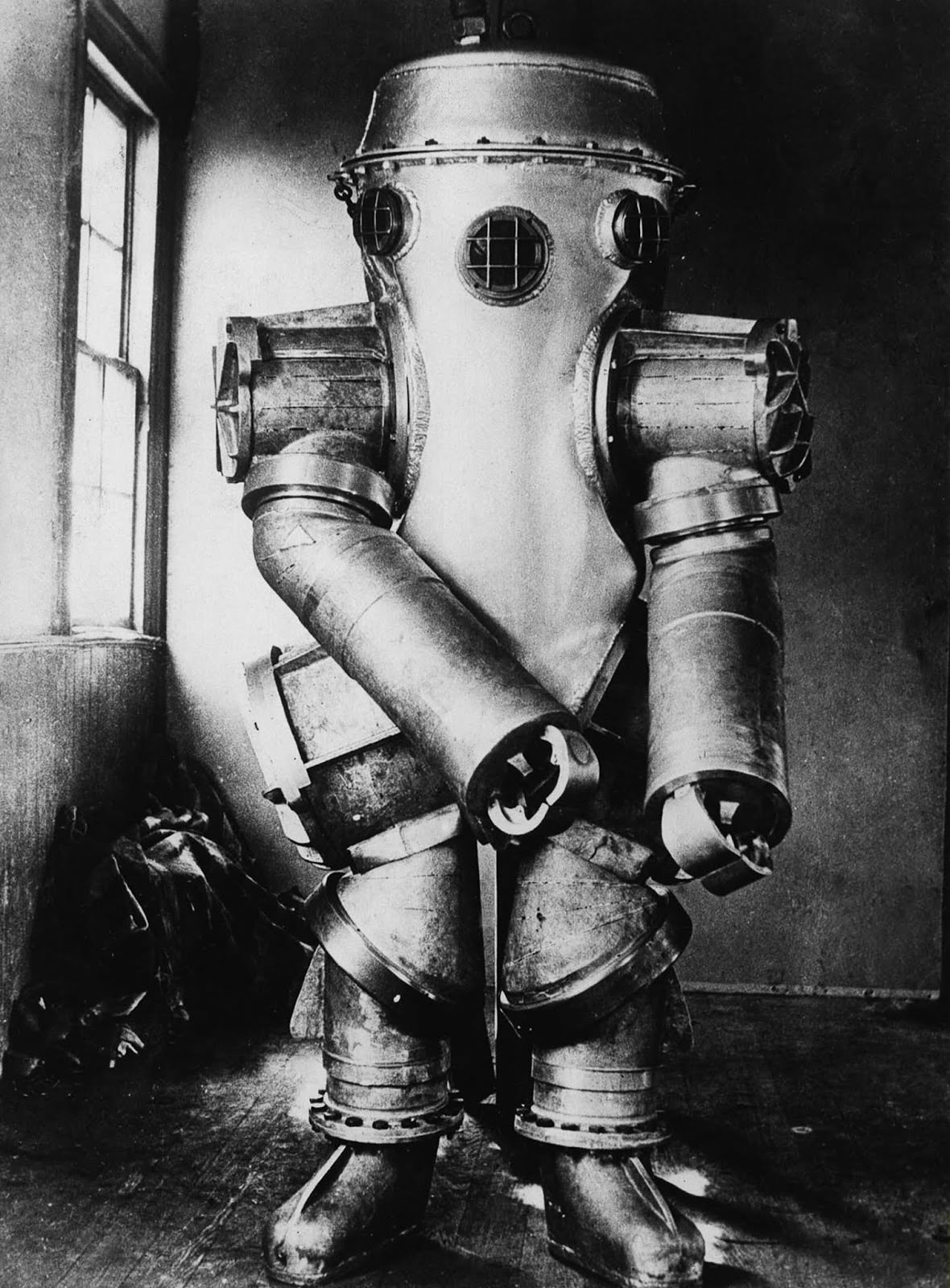
Standing like a small steel monument, Bowdoin’s diving suit from 1934 looks less like clothing than a machine built to be worn. The bulbous helmet with its round, gridded viewports crowns a thick torso, while oversized arm and leg joints suggest the challenge of moving under pressure. Light from a nearby window skims across the metal, emphasizing rivets, seams, and the hard practicality of early deep-sea engineering.
What draws the eye is the suit’s uncompromising design: heavy boots planted wide, cylindrical sleeves ending in mechanical cuffs, and broad shoulder sections that hint at internal air management and rigid support. The figure becomes almost architectural, a fusion of workshop craft and maritime ambition—an “invention” in the purest sense, meant to extend human reach into an environment that resists it at every turn. Even at rest indoors, it carries the aura of an expedition tool, built for risk and reliability rather than comfort.
For readers interested in the history of diving technology, this photo offers a striking snapshot of interwar innovation and the era’s confidence in metal, seals, and engineering solutions. It’s a reminder that exploration has often depended on cumbersome prototypes before refinement arrives, and that progress sometimes begins with equipment that seems fantastical by modern standards. As a WordPress feature, “Bowdoin’s diving suit. 1934.” pairs beautifully with stories of maritime research, mechanical invention, and the evolving relationship between humans and the sea.