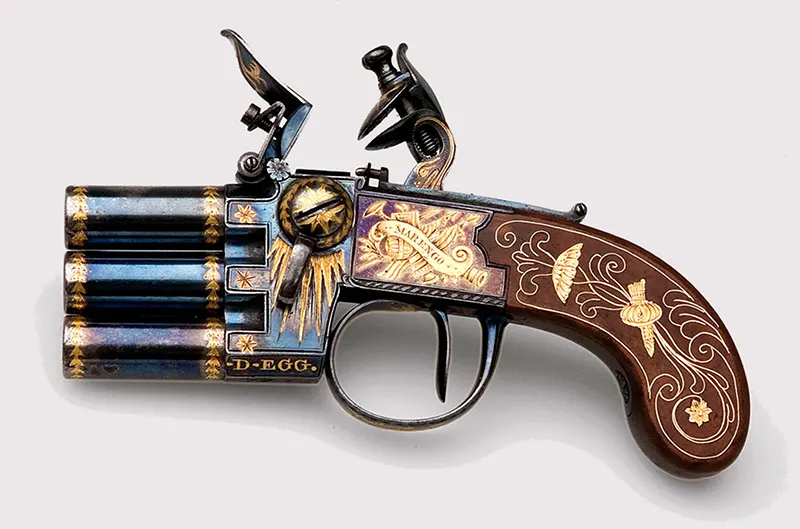
Few objects sum up the marriage of power and craftsmanship like Napoleon’s three-chamber box lock pistol (1802), a compact weapon that looks as much like a courtly showpiece as a tool of war. The dark metal body is set off by bright gilded accents, with ornament concentrated around the lock and along the grip where delicate scrollwork and floral motifs catch the eye. Even at a glance, the careful finishing suggests an era when personal arms could function as status symbols, carried not only for protection but also for display.
The “three-chamber” design points to an inventive answer to a perennial problem of early firearms: how to fire more than once without the long pause of reloading. Instead of a single barrel and charge, this pistol presents multiple aligned chambers at the front, hinting at a practical attempt to increase readiness in close quarters. Its box lock mechanism—compact, enclosed, and visually tidy—reflects a period of experimentation in small-arms engineering, when reliability, speed, and portability pushed gunsmiths to rethink familiar forms.
Collectors and history enthusiasts often gravitate to pieces like this because they sit at the crossroads of Napoleonic-era military culture and technical innovation. The rich decorative program, paired with the pistol’s unusual multi-chamber layout, makes it an ideal subject for anyone exploring antique firearms, early 19th-century inventions, or the material world surrounding Napoleon’s rise. As a historical photo, it offers a clear look at the details that matter: the mechanics, the materials, and the unmistakable intent to impress as much as to perform.