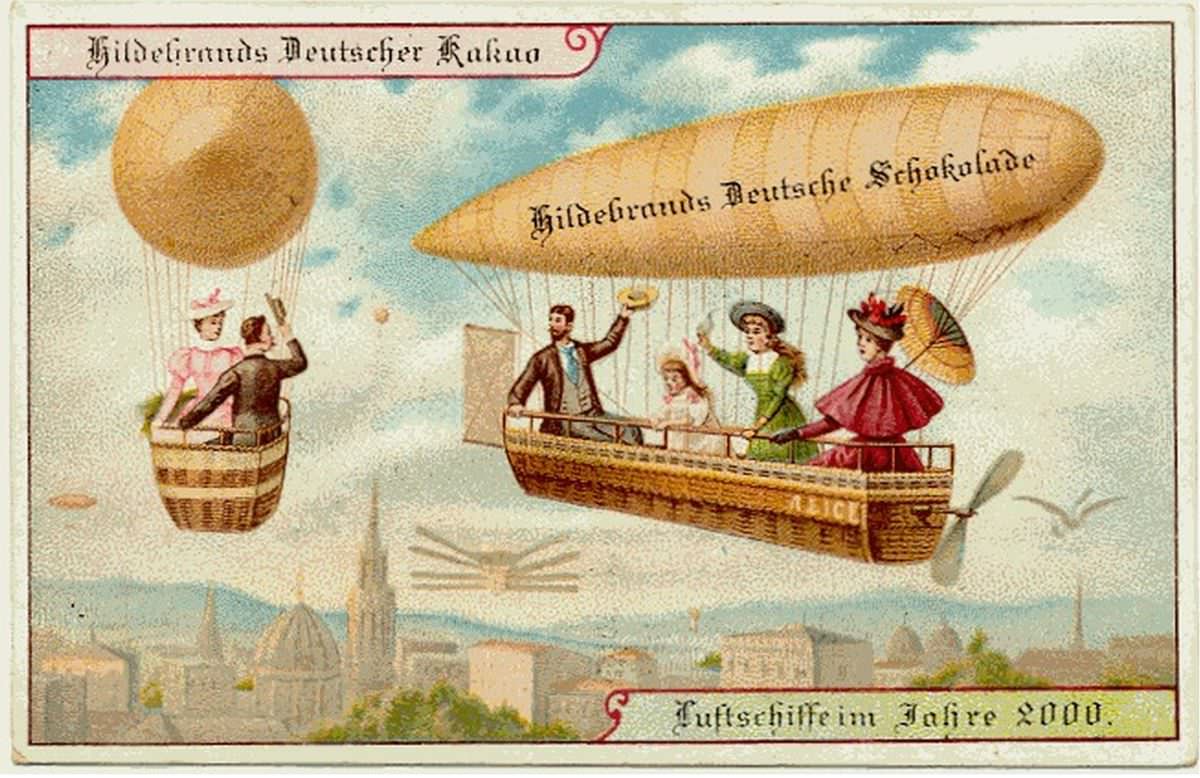
Floating above a hazy city skyline, a pair of airy contraptions turns commuting into a parlor-game fantasy: one little balloon basket for two, and one elongated, blimp-like “personal airship” carrying a small party as if it were a pleasure boat in the clouds. The passengers are dressed in formal attire—hats, coats, and even a parasol—waving as they drift along, while the craft itself resembles woven wicker suspended by cords. The whimsical details suggest a playful vision of everyday flight, where the sky becomes just another boulevard.
German text printed across the envelope reads “Hildebrands Deutsche Schokolade,” making it clear this is also an advertisement, not merely a dream of the future. At the bottom, the caption “Luftschiffe im Jahre 2000” frames the scene as a prediction—airships in the year 2000—packaging tomorrow’s technology as a charming, consumer-friendly spectacle. In other words, it sells chocolate by selling wonder, borrowing the era’s fascination with balloons and dirigibles to promise progress with a smile.
“Personal airships” here aren’t about efficiency so much as imagination: tiny private craft, polite passengers, and an airy, optimistic city beneath them. The picture belongs to that rich tradition of future-themed ephemera—trade cards and illustrated ads that let people daydream about aviation long before it became ordinary. Funny, yes, but also revealing: it shows how early popular culture pictured the future as graceful, leisurely, and just slightly absurd, all while keeping a brand name drifting front and center in the sky.