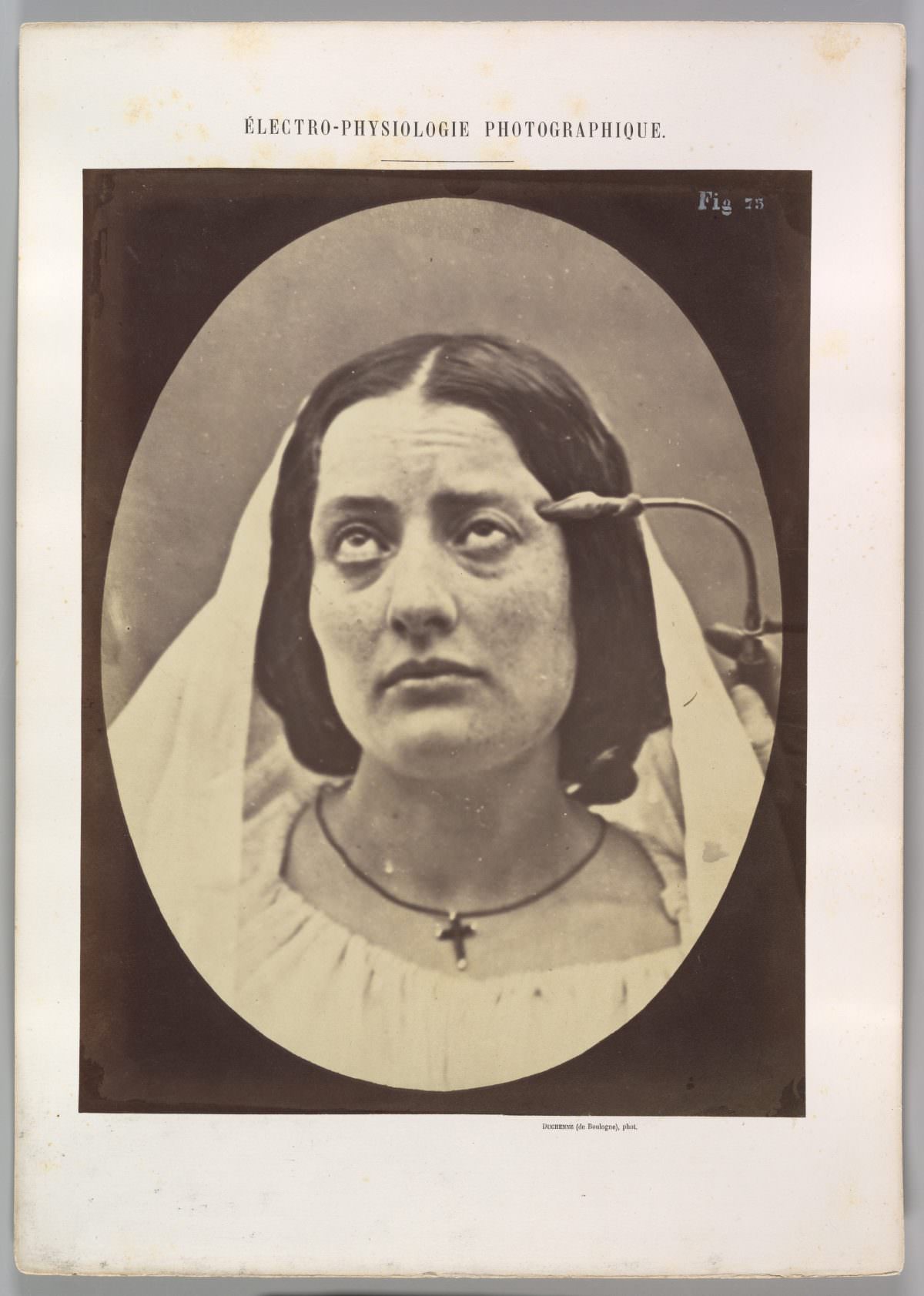
A woman in a nun’s veil fills the frame, her face caught in a moment of intense inward focus as her eyes lift upward. The simple cross at her throat and the plain neckline evoke devotional life, yet the setting feels curiously clinical rather than purely sacred. Instead of a candlelit chapel, a small instrument hovers near her temple, turning a private act of prayer into something observed and measured.
Printed above the portrait is the French title “ÉLECTRO-PHYSIOLOGIE PHOTOGRAPHIQUE,” with a small figure number at the edge, suggesting this was made for study as much as for art. The oval framing, the strong contrast, and the careful pose recall the era when photography served science, medicine, and psychology, cataloging expressions and bodily responses with the authority of the lens. Here, faith and experimentation meet in a single, unsettling composition: reverence rendered as data.
For readers drawn to religious history, early photography, or the visual culture of scientific inquiry, “Nun saying prayer” offers rich ground for reflection. The photograph works on two levels at once—an intimate devotional portrait and a document from a time when human emotion was increasingly scrutinized by new technologies. As part of a collection of artworks, it invites questions about consent, curiosity, and the thin line between spiritual experience and the modern urge to explain it.