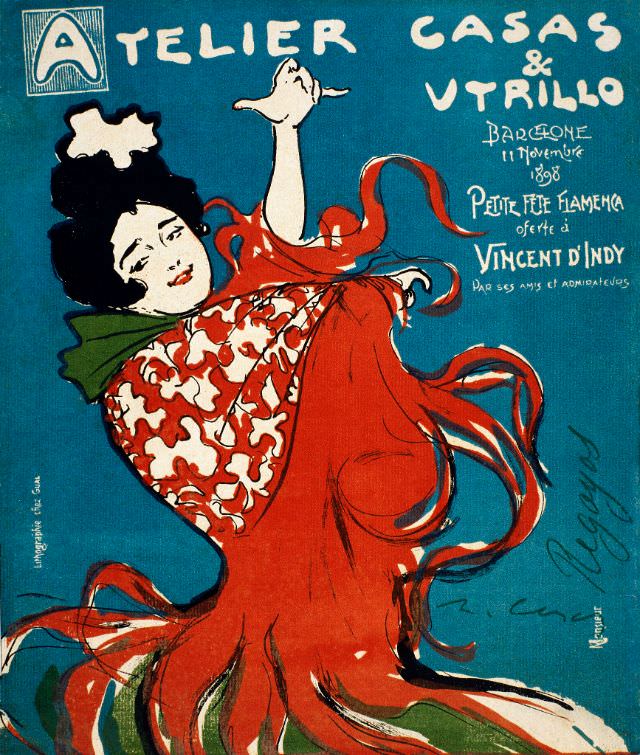
A bold sweep of blue sets the stage for a swirling flamenco dancer, her red dress exploding into ribbon-like curves that seem to move even on paper. The stylized figure—dark hair piled high, pale face turned in mid-gesture—signals the energy of Barcelona’s late‑19th‑century art scene, when posters and prints were becoming public spectacles as much as announcements. With its theatrical palette and simplified forms, the artwork reads as both advertisement and modern design statement.
Lettering across the top identifies “Atelier Casas & Utrillo,” with “Barcelone” and the year 1898 anchoring the piece in its moment. The hand-drawn text below evokes a program or invitation, mixing French phrasing with a distinctly Spanish subject, and reflecting the cosmopolitan currents that flowed through the city’s cafés, studios, and performance halls. The overall composition balances typography and illustration so closely that the words feel like part of the dance.
For collectors and researchers of Barcelona poster art, this image offers an immediate lesson in how Art Nouveau-era graphics could sell an event while shaping a city’s visual identity. The dancer’s dramatic silhouette, the saturated colors, and the lively brushwork make it especially compelling for anyone searching for “Atelier Casas & Utrillo Barcelone 1898” or exploring historical artworks tied to music, performance, and modernist print culture. It’s a vivid reminder that, in the 1890s, the street poster was already a gallery wall open to everyone.