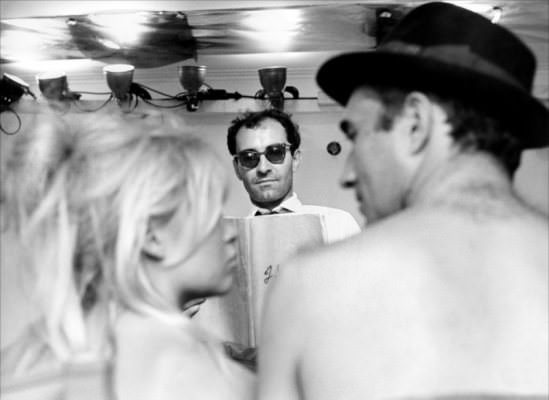
Between the soft blur of a blonde profile and the bare shoulder of a man in a dark hat, a third figure locks the scene into place: a sunglasses-wearing observer framed by bright studio bulbs and a reflective wall. The composition feels deliberately voyeuristic, as if we’ve stepped onto a film set mid-take, where glances matter as much as dialogue. In the context of Jean-Luc Godard’s *Le Mépris* (1963), that layered perspective becomes its own story—desire, surveillance, and performance all pressed into a single moment.
Godard’s cinema often turns the act of looking into the real drama, and this photograph echoes that tension with almost cruel clarity. The couple in the foreground is intimate yet withheld from us, while the man at center—cool, distant, and sharply lit—seems to judge, direct, or simply consume what he sees. It’s a visual shorthand for the film’s famous emotional geometry: love curdling into contempt, tenderness interrupted by ego, and the movie industry’s machinery hovering just out of frame.
Bardot’s presence, suggested here through the luminous hair and close-cropped proximity, pulls the viewer toward the film’s central question of how a woman is seen, possessed, and misunderstood in both marriage and cinema. Searchers drawn to *Le Mépris*, Brigitte Bardot, Godard’s French New Wave style, or behind-the-scenes film photography will find a compelling entry point in this image’s uneasy intimacy. More than a nostalgic snapshot, it reads like a quiet argument about power—who holds it, who loses it, and what the camera chooses to make undeniable.