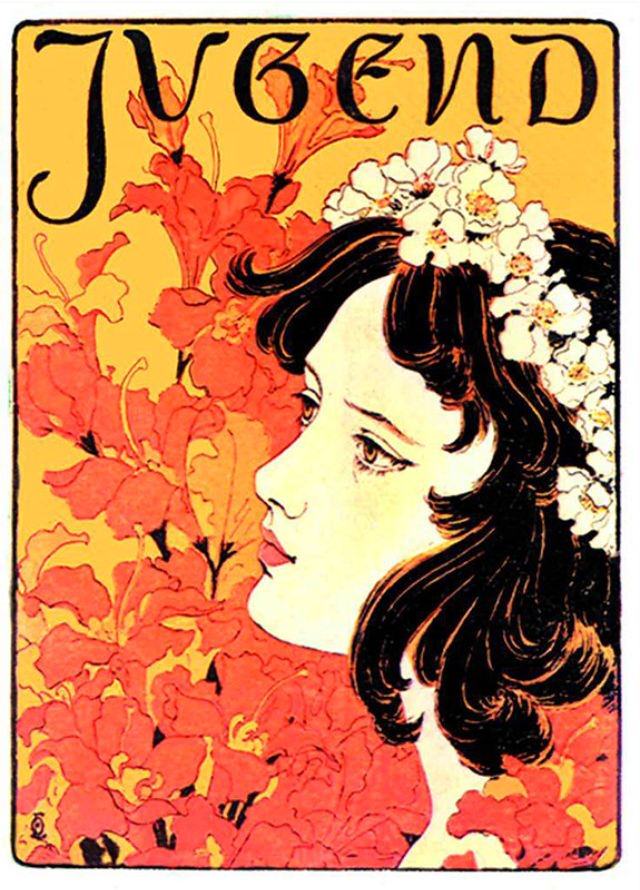
Across the top, the word “Jugend” crowns a striking cover design whose warm gold ground and bold black lettering immediately announce the confident graphic language of the late 19th century. A young woman’s profile, rendered with clean contours and soft shading, turns toward a dense spray of scarlet blossoms that fills the left half of the composition. The palette—flame reds, honeyed yellows, and inky hair—creates an intense, poster-like clarity that still reads powerfully on modern screens.
Floral abundance isn’t merely decoration here; it frames the figure as an emblem of youth itself, poised between delicacy and vitality. White flowers nestled in dark, glossy curls add a note of freshness, while the stylized petals and flattened space hint at the emerging Art Nouveau sensibility that favored flowing lines and nature motifs. The result feels both intimate and theatrical, like a quiet moment turned into a public statement.
For readers searching for “Jugend 1896” cover art, this image offers a vivid glimpse into the era’s visual culture, when illustrated periodical covers and posters helped define taste long before digital media. The composition balances typography, portraiture, and botanical ornament in a way that explains why such designs remain popular in art history, graphic design study, and vintage print collecting. As a historical artifact, it invites a closer look at how youth, beauty, and modernity were packaged—quite literally—at the threshold of a new century.