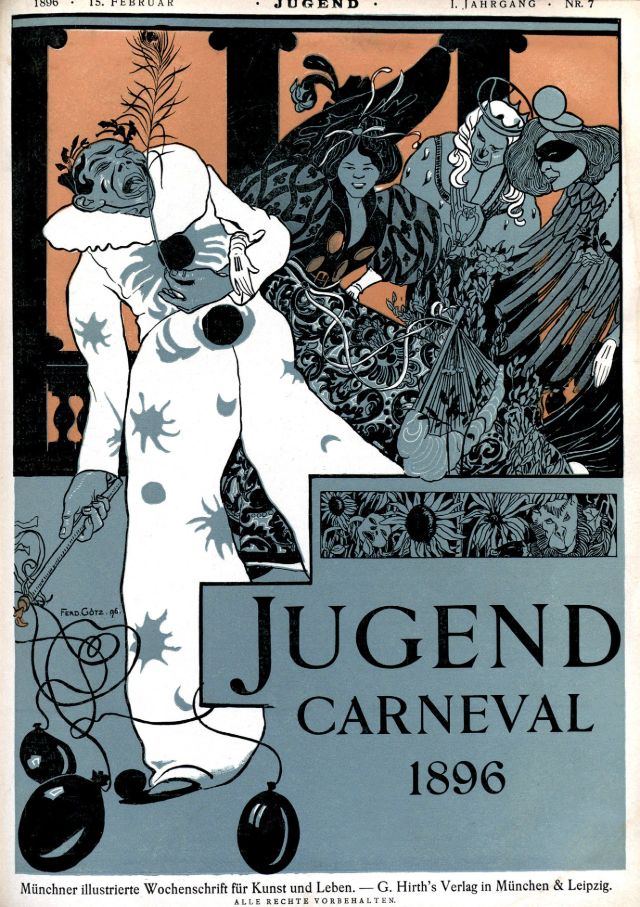
Across the top margin, “JUGEND” and the February 1896 dating frame this as cover art for the celebrated illustrated weekly, and the central caption—“Carneval 1896”—announces a festive theme with graphic confidence. The composition is dominated by a towering Pierrot-like clown in loose white costume, his posture slack and theatrical as if mid-stumble or mid-bow. Around him, masked revelers lean in from behind a dark doorway, their faces half-hidden by costume and shadow, pulling the viewer into the conspiratorial mood of carnival.
Art Nouveau curves run everywhere: looping ribbon-like lines at the lower left, floral patterns across fabrics, and stylized shapes that flatten space into decorative panels. The palette—muted blues, blacks, and warm tan—creates a poster-like clarity that would have stood out on a newsstand, while still retaining the intimacy of magazine illustration. Even small details, such as the scattered jester bells and the dense ornament of clothing, reinforce the sense of excess and play that carneval promised.
As a historical print, this Jugend cover sits at the crossroads of modern graphic design and late-19th-century urban entertainment, where masquerade could be both escape and satire. The image’s exaggerated gestures and masked glances suggest performance—who is watching, who is being watched, and who is merely acting a part for the season. For readers searching “Jugend Carneval 1896” or “Jugend magazine cover art,” it’s a striking example of period illustration that captures the spectacle, mystery, and stylized elegance associated with fin-de-siècle carnival culture.