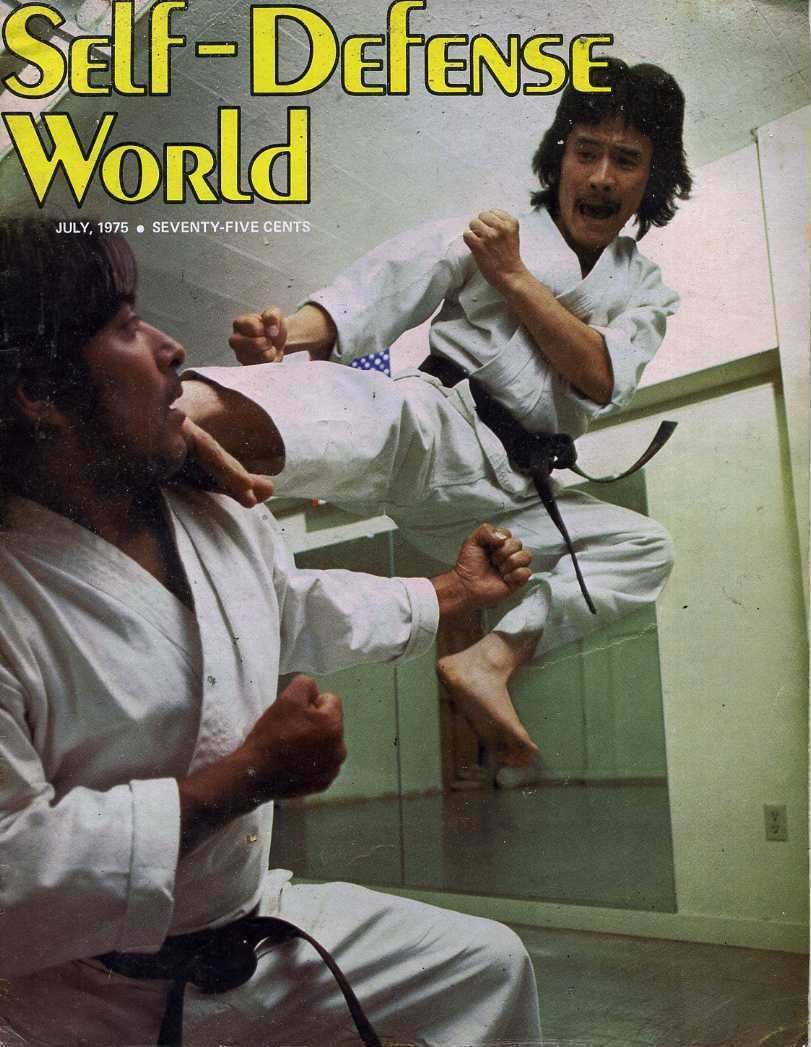
Bold yellow lettering shouts “Self-Defense World” across a well-worn magazine cover, dated July 1975 and priced at seventy-five cents—instant proof of how mainstream martial arts culture had become in the era of newsstands and glossy pulp. Beneath the masthead, two men in white gi and black belts collide in a staged burst of motion: one launches a flying kick, the other braces with clenched fists, their expressions tuned for maximum drama. Even the scuffs, fading, and edge wear read like history, hinting at how often this issue may have been thumbed through by would-be fighters and curious fans alike.
Inside the frame, the setting feels like a plain training room—mirrors along the wall, bare floor, utilitarian corners—yet the cover turns it into a cinematic arena. That mix of ordinary dojo reality and larger-than-life action was the secret sauce of 1970s and 1980s martial arts magazines, where technique, toughness, and pop spectacle blended together on every rack. The composition sells impact: a suspended kick, a tense guard, and the promise that self-defense knowledge could be purchased as easily as the next issue.
Nostalgia hangs over this artifact in a way that speaks directly to the post’s theme, “Everybody Was Kung Fu Fighting,” and the heyday when martial arts mags helped define an entire subculture. Covers like this worked as both instruction and invitation, pulling readers into a world of karate, kung fu, and fighting lore long before online tutorials and streaming documentaries. For collectors, designers, and martial arts historians, it’s a vivid snapshot of magazine-cover art at peak intensity—part advertisement, part mythmaking, and unmistakably of its time.