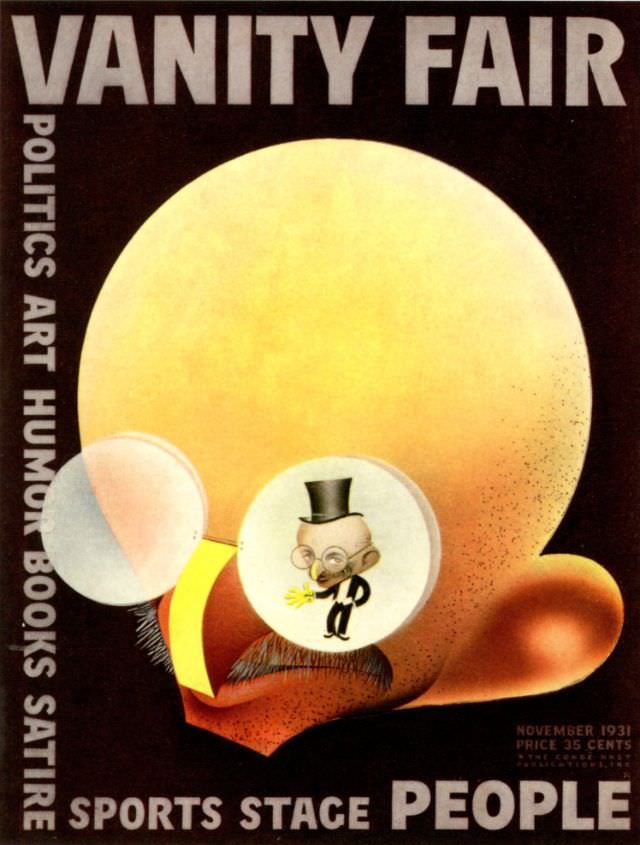
Bold lettering shouts “VANITY FAIR” across the top, framing an arresting piece of cover art from November 1931 that feels both playful and razor-sharp. A gigantic, bald head dominates the composition, rendered in warm, airbrushed tones against a dark background, while the magazine’s promised mix of “POLITICS ART HUMOR BOOKS SATIRE” runs down the side like a manifesto. The design’s clean geometry and theatrical scale give it that unmistakable early-20th-century magazine-cover confidence.
At the center, round spectacles become miniature stages, turning a simple face into a visual joke with layers: a tiny, top-hatted figure appears inside one lens, as if the wearer’s perspective contains an entire character. The oversized ear and the softly shaded skin textures push the caricature into near-surreal territory, balancing elegance with absurdity. Even without a named subject, the illustration communicates how Vanity Fair covers of the era could comment on “people” and public life through wit rather than literal portraiture.
Along the bottom, the words “SPORTS STAGE PEOPLE” read like a snapshot of what captured attention in the interwar years, hinting at celebrity, performance, and social spectacle. The printed “NOVEMBER 1931” and “PRICE 35 CENTS” anchor it firmly as a period artifact—part advertisement, part cultural timestamp. For collectors, designers, and history-minded readers, this Vanity Fair cover offers a vivid example of 1930s editorial illustration and the magazine’s knack for packaging commentary as irresistible style.