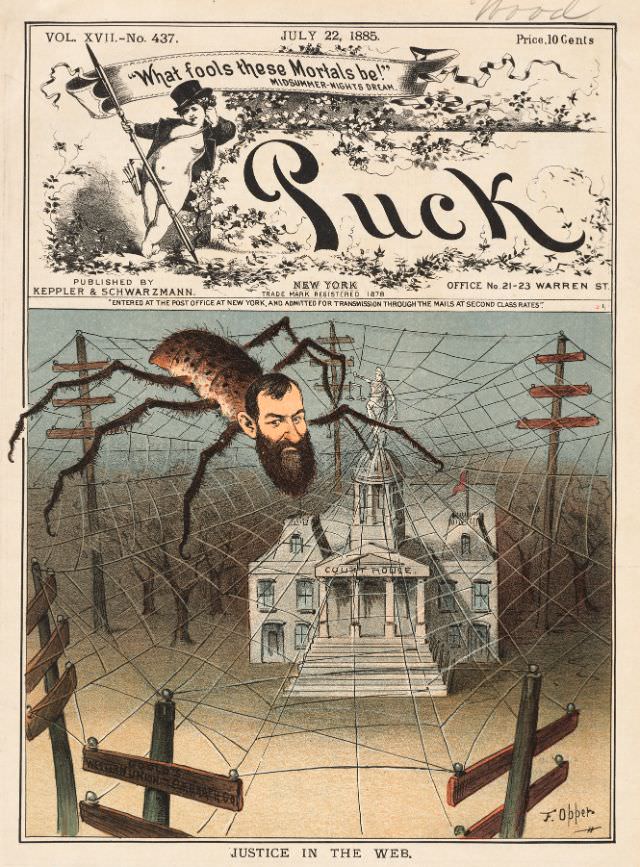
Bold lettering sweeps across the top of this Puck magazine cover dated July 22, 1885, framed by decorative flourishes and a theatrical banner that hints at satire before the main scene even begins. The masthead and publishing details anchor it firmly in the world of late-19th-century American print culture, when illustrated weeklies competed for attention on newsstands with striking typography and color lithography. Even at a glance, the design feels engineered to pull readers in—part showbill, part political warning.
Dominating the composition below, a courthouse sits at the center of an enormous spider web, while a giant spider bearing the head of a bearded man looms over the building like a predatory force. Telegraph poles and wires recede into the background, reinforcing the sense of a modern network—lines of communication and influence—entangling the institutions meant to deliver fairness. A lone figure stands high on the courthouse structure, dwarfed by the web’s geometry, suggesting how small individual agency can appear when power is organized and pervasive.
The caption at the bottom, “Justice in the Web,” makes the message explicit: this is editorial cartooning aimed at corruption, manipulation, and systems that trap the public while pretending to serve it. As cover art, it functions both as a historical artifact and as a snapshot of the anxieties of its era, when courts, corporations, and infrastructure were increasingly intertwined in the public imagination. For collectors, researchers, and anyone browsing Puck magazine covers, the piece offers a vivid example of how illustration once shaped political conversation as sharply as headlines.