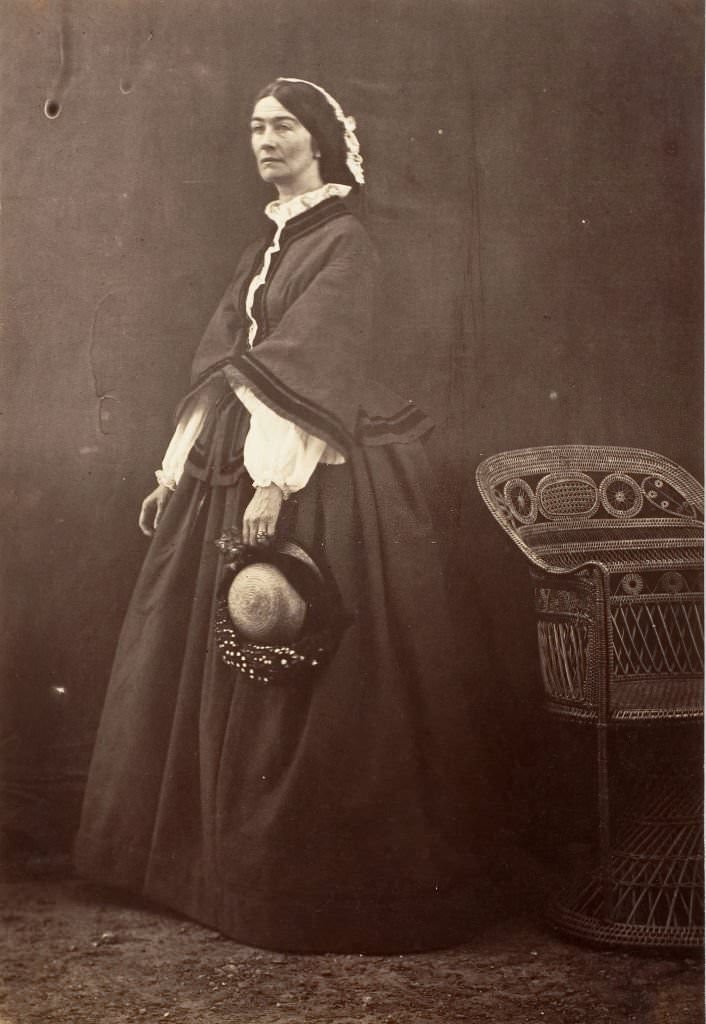
Poised in three-quarter profile, the Countess Canning stands against a plain studio backdrop in Simla, her gaze set slightly past the camera with the composed reserve common to mid-19th-century portraiture. The long dress spreads into a generous skirt, suggesting the fashionable crinoline silhouette of the era, while a dark wrap or mantle drapes over her shoulders. A white ruffled collar and full cuffs brighten the otherwise sombre palette, and a small bonnet or hat hangs from her hand as a subtle finishing touch.
Details of dress and setting make this a rich document of Victorian fashion and colonial social life, where clothing signaled rank as much as taste. The structured skirt, carefully arranged fabric, and restrained trimming speak to formal etiquette, while the lace at the sleeves and the crisp neckline draw attention to craftsmanship and materials. Beside her, a wicker chair with decorative weaving adds texture and hints at the furnishing styles associated with verandas and drawing rooms in hill-station society.
Taken in 1861, the portrait reads as both personal likeness and cultural artifact, preserving how elite women presented themselves for the camera at a time when photography was becoming an instrument of status and memory. The controlled pose, minimal props, and even lighting emphasize dignity over intimacy, inviting the viewer to study silhouette, accessories, and posture. For researchers and enthusiasts of Fashion & Culture, “The Countess Canning, Simla, 1861” offers a vivid window into crinoline-era style and the visual language of authority in the nineteenth century.