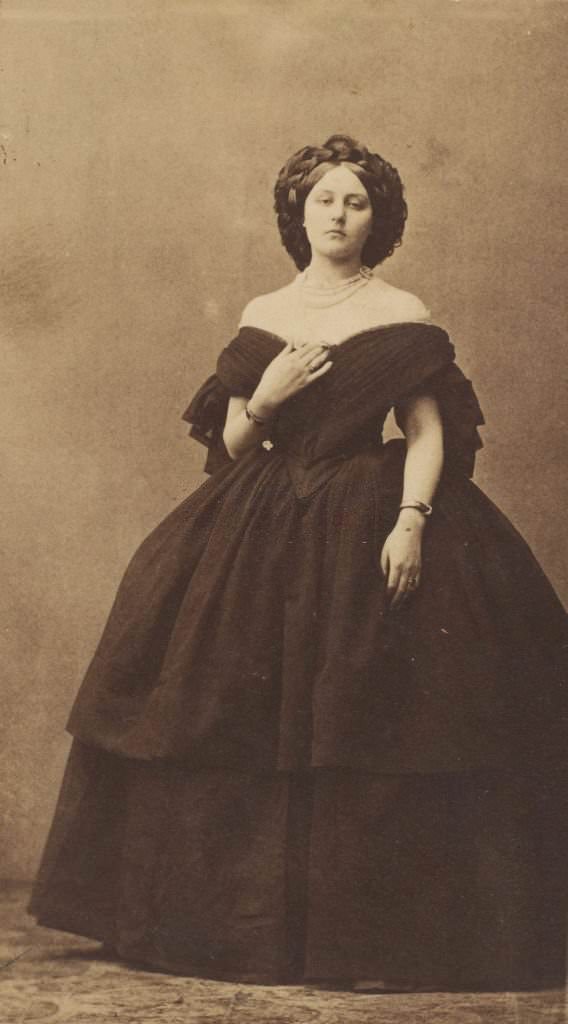
Poised against a plain studio backdrop, a woman stands in the unmistakable silhouette of the 1860s, her skirt swelling outward in the rounded breadth associated with crinolines. The title, “Les beau d collet,” draws attention to the neckline: an off-the-shoulder bodice that frames the collar and shoulders, balancing softness with the era’s structured engineering. Even without a visible setting, the careful pose and centered composition suggest a formal portrait meant to preserve both likeness and style.
Dark fabric dominates the dress, absorbing light and emphasizing the sweep of the gown’s volume, while the bodice sits smooth and fitted before giving way to generous folds. A small necklace rests at the throat and bracelets catch the eye at the wrists, restrained accessories that still signal taste and status. Her hair is arranged in full, rounded waves typical of mid-19th-century fashion, reinforcing the period look as surely as the dress itself.
As a piece of fashion and culture history, the photograph reads like a lesson in how Victorian femininity was constructed—through understructures, tailored seams, and the deliberate display of the décolletage. The absence of props keeps attention on the interplay between body, garment, and pose, a common studio strategy in early portrait photography. For anyone searching 1860s women’s fashion, crinoline dresses, or Victorian neckline styles, this image offers a vivid, intimate window into the aesthetics of the decade.