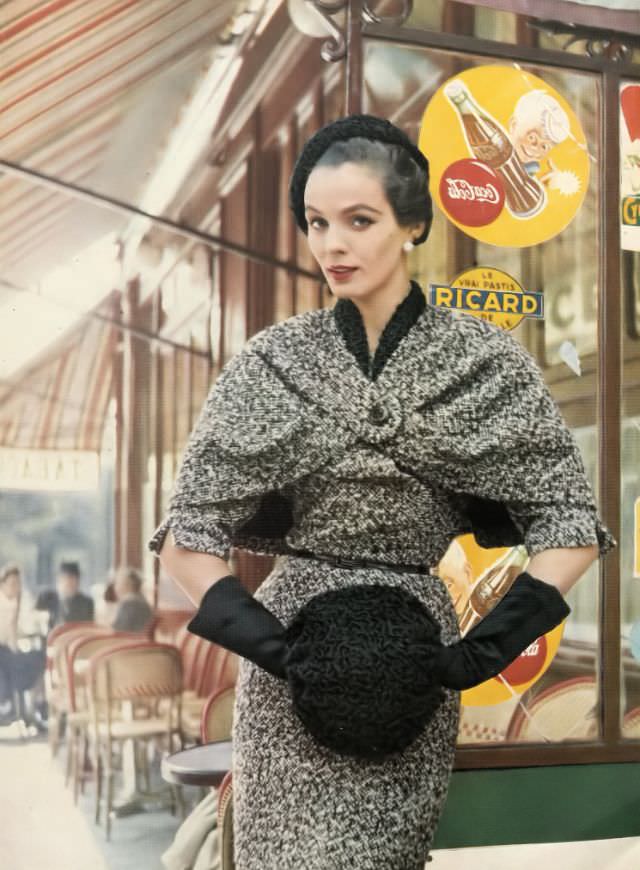
Poised at the edge of a Parisian café terrace, Linda Harper wears Jacques Fath’s nubby black-and-white tweed with an ease that reads both modern and unmistakably 1953. The fabric’s rough, peppered texture is balanced by a sculpted silhouette: a wrapped, cape-like bodice cinched at the waist and falling into a slim skirt that emphasizes the era’s disciplined line. Her dark gloves and a rounded Persian lamb muff add depth and softness, turning the look into a study in contrast—matte against sheen, structure against plush.
Behind her, the city’s everyday advertising and glass storefront reflections place couture directly in the street rather than on a salon staircase. Café chairs and tables recede in perspective, suggesting a busy boulevard just outside the frame, while bright circular signs punctuate the background like mid-century graphic design. That tension—high fashion set against ordinary urban life—captures how postwar Paris sold glamour as something you could glimpse through a window, even if you couldn’t yet afford it.
Harper’s styling completes the narrative of 1950s fashion modeling: controlled posture, direct gaze, and a hat set neatly to frame the face and emphasize the dramatic brows and lipstick of the period. Fath’s choice of tweed and Persian lamb speaks to luxury built from tactile materials, where craftsmanship mattered as much as the silhouette. For historians of fashion and culture, the photograph doubles as a street-level record of Paris couture in motion, blending designer elegance with the lived atmosphere of the city.