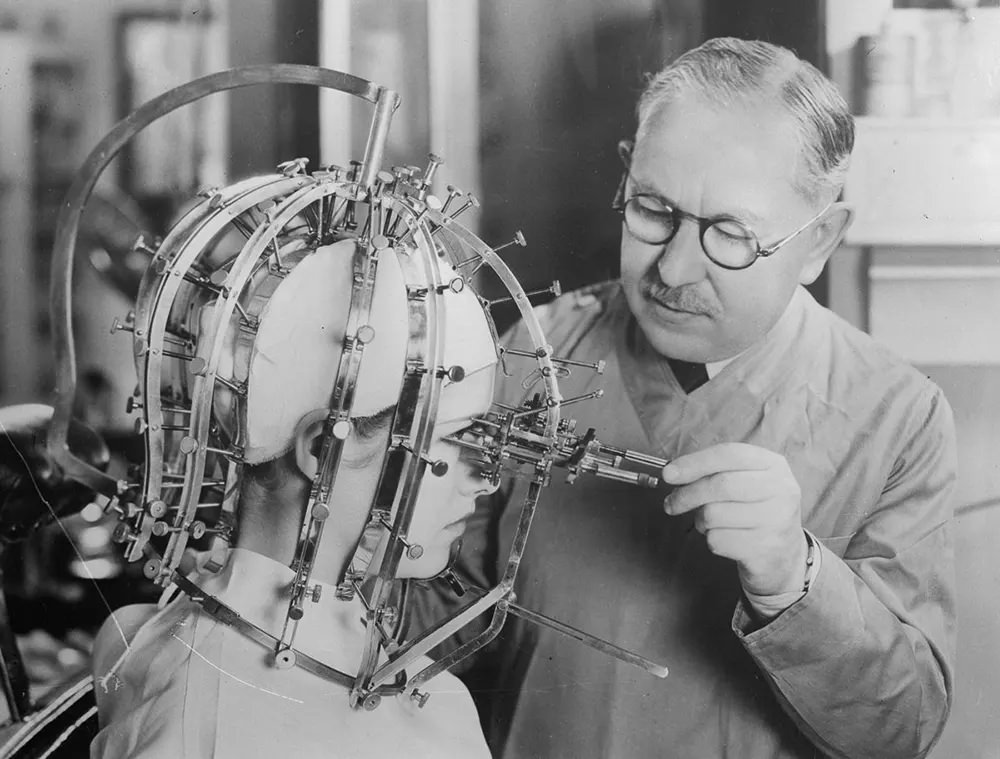
A woman sits in profile while a man in round spectacles leans in, intent on the intricate metal framework encircling her head. The contraption—a “beauty micrometer” or beauty calibrator—bristles with adjustable screws and measuring arms, turning her face into something to be mapped and quantified. Her expression is calm and resigned, as if this careful inspection were simply another step in a modern routine.
The scene reflects an era when fashion, cosmetics, and popular science frequently overlapped, borrowing the authority of instruments and laboratory-like precision. With its cage-like arcs and calibrated points, the device suggests that symmetry and proportion could be engineered, that “flaws” might be detected the way a machinist checks tolerances. Even without a visible salon sign or clinic label, the staged measurement speaks to the period’s fascination with scientific beauty standards and the promise of corrective expertise.
What makes the photograph so striking is its tension between intimacy and mechanics: a human face reduced to coordinates, improvement pursued through hardware. As a piece of cultural history, it offers a vivid snapshot of early 20th-century beauty technology, where ideals were treated as measurable targets rather than personal choices. For anyone exploring vintage beauty devices, cosmetic history, or the social pressure behind “perfect” features, the image remains both fascinating and unsettling.