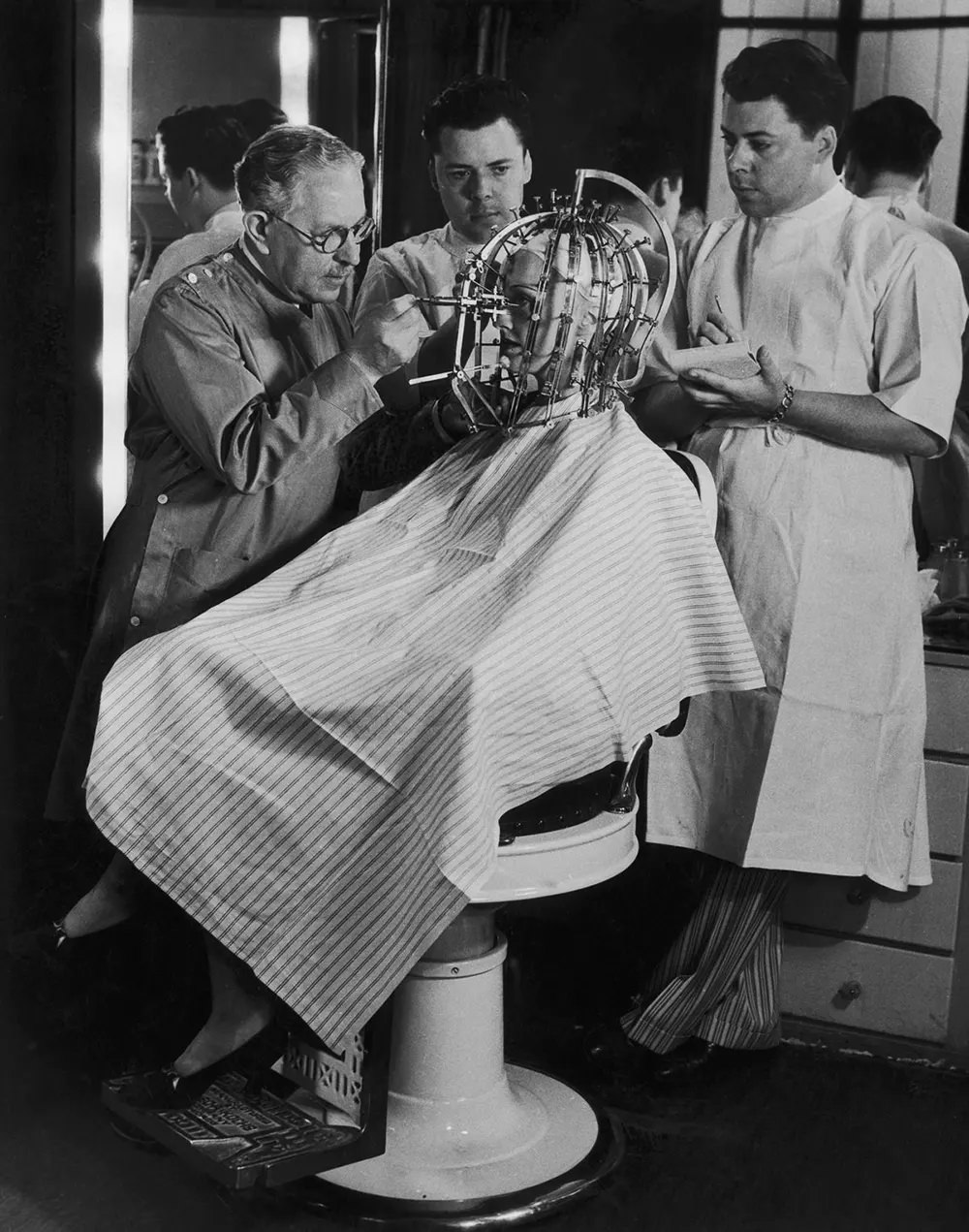
Under the bright studio lights, a seated woman in a barber-style chair wears a cage-like “beauty calibrator” over her head, the metal framework bristling with screws and measuring arms that press close to the brow, cheeks, and chin. An older technician in a smock leans in with careful focus, adjusting the apparatus as if tuning a scientific instrument, while two younger assistants watch—one poised with a notepad, ready to record each reading. Reflections in the mirrors behind them multiply the scene, reinforcing the clinical, almost laboratory atmosphere of a beauty salon turned measurement room.
The device embodies a 1930s fascination with turning appearance into data, promising to “analyze” facial proportions and identify supposed flaws with mechanical precision. Rather than relying on an artist’s eye or a cosmetician’s intuition, the calibrator suggests a modern, engineered approach to makeup application, hairstyling, and corrective techniques—symmetry quantified, contours mapped, individuality reduced to adjustable points. Its intimidating geometry, halfway between orthodontic headgear and drafting equipment, makes visible the era’s belief that technology could perfect the human face.
Fashion and culture in this period often blended glamour with the language of science, and the beauty calibrator sits squarely at that intersection—part marketing spectacle, part confidence trick, part genuine attempt at standardization. The men in white coats lend authority, as if beauty were a problem to be solved with tools and measurements rather than taste and self-expression. Today the photograph reads as both curious and unsettling, a reminder that the pursuit of “ideal” features has long been shaped by instruments, experts, and social pressure—even before the age of filters and facial-recognition algorithms.