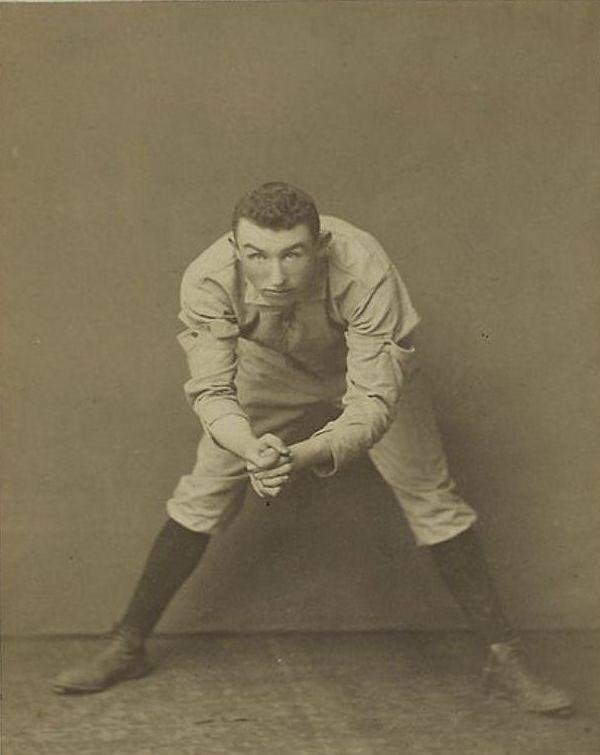
Leaning forward with knees bent and hands clasped around a bat, the player fixes the camera with a steady, almost challenging stare. The plain studio backdrop strips away the ballpark and the crowd, leaving only posture, uniform, and intent—an early baseball portrait where the pose has to suggest motion that the exposure time couldn’t easily catch.
Details like the rolled sleeves, heavy socks, and sturdy shoes hint at the practical realities of 19th-century baseball, when equipment was simpler and uniforms read more like workwear than modern athletic gear. The bat becomes both prop and proof of identity, staged carefully in a controlled indoor setting where photographers could craft a crisp, marketable likeness for fans and team promotion.
Before action shots became the sport’s visual language, studio photos like this helped define what a baseball player looked like: disciplined, ready, and built for the gritty rhythm of the game. For collectors, historians, and anyone searching for early baseball photography, this kind of posed portrait offers a vivid window into the era’s aesthetics—where performance was implied through stance, not captured mid-play.