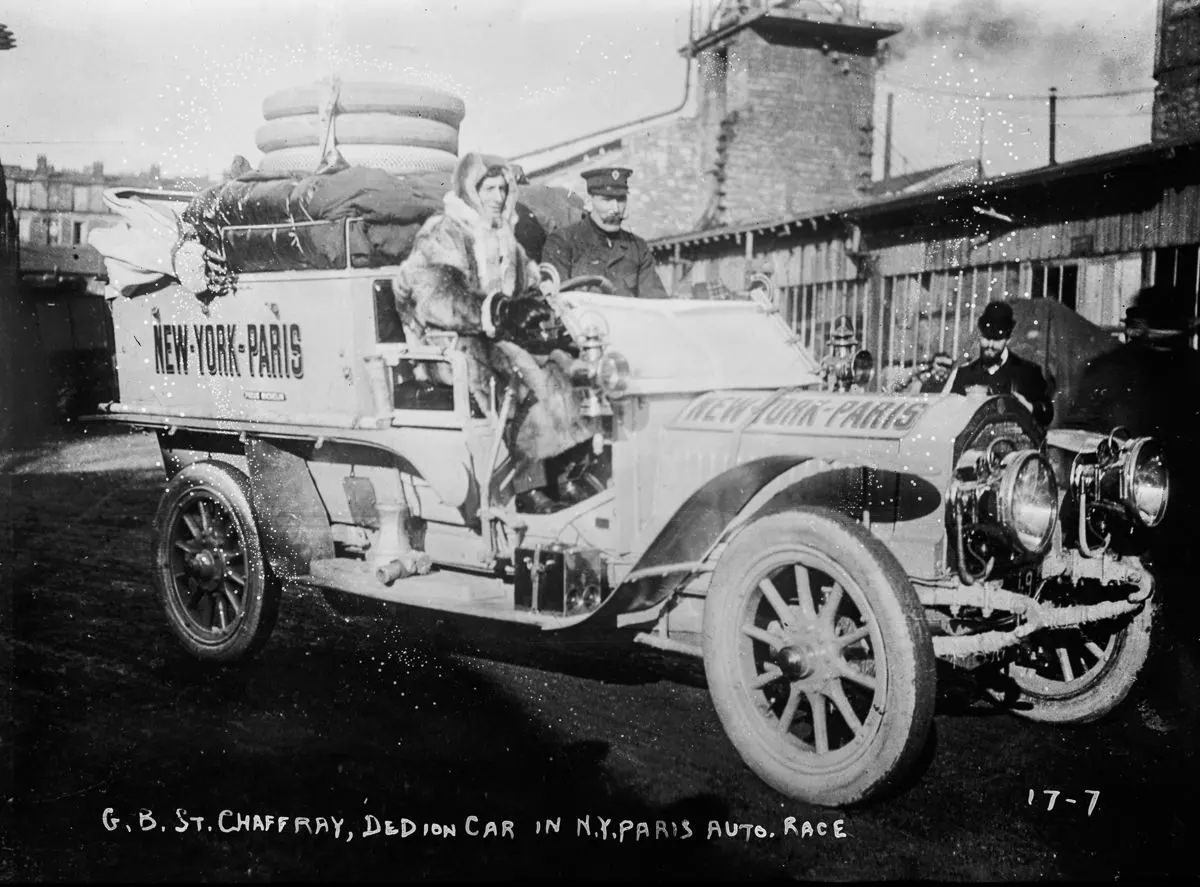
G. Bourcier de St. Chaffray sits high at the controls of the French De Dion, a machine prepared for the punishing ambition of the New York–Paris Auto Race. The car’s body carries bold “NEW YORK–PARIS” lettering, while its open cockpit, exposed lamps, and spoked wheels speak to an era when long-distance motoring was still an experiment in courage and mechanics.
Bundled against the elements, the driver’s heavy coat and gloves hint at the bitter wind and road spray that early racers endured in unheated, roofless cars. Behind him, the De Dion is stacked with supplies and spare tires, a rolling workshop as much as a competitor—evidence that survival on the route depended on improvisation as much as speed.
In the background, uniformed figures and onlookers frame the scene like a departure platform, underscoring how public and ceremonial these early automotive contests could be. For readers exploring 1908 endurance racing, pioneering French automobiles, and the legendary New York to Paris challenge, this photograph offers a vivid snapshot of the grit, planning, and spectacle that defined motorsport at the dawn of the modern age.