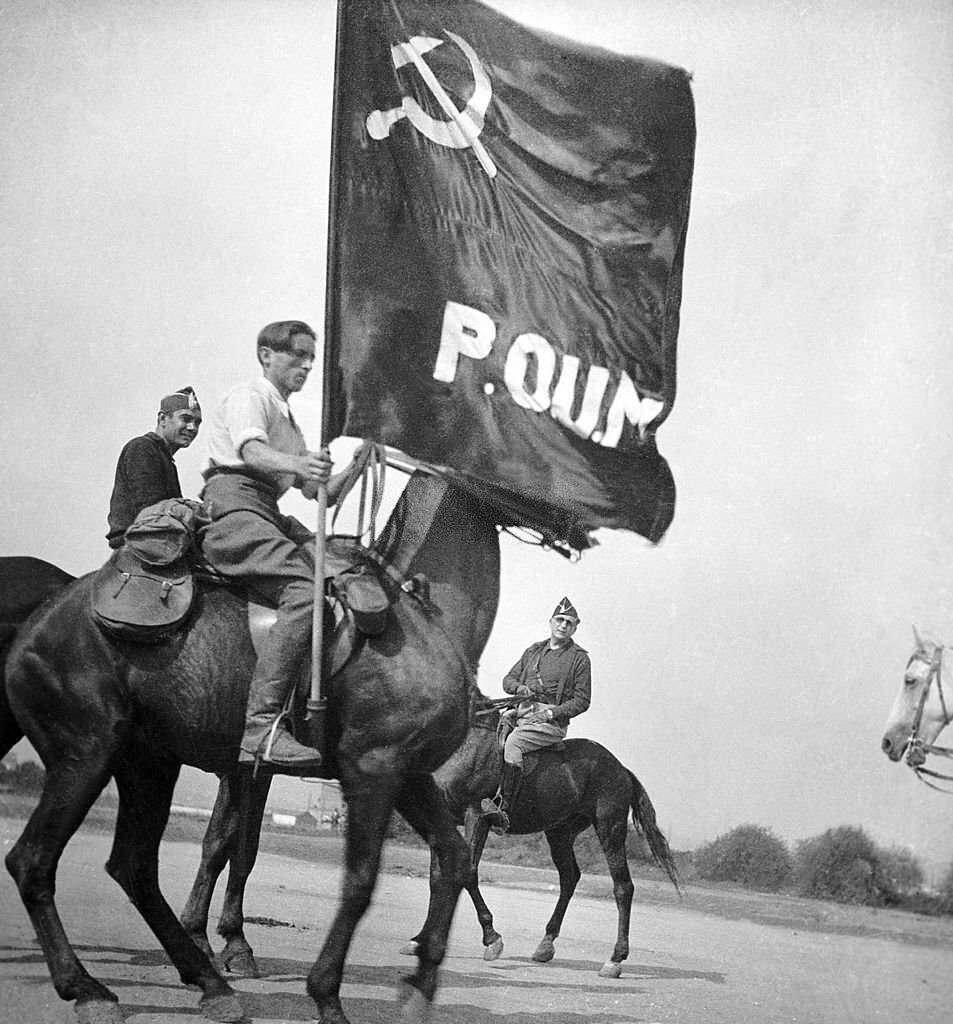
Wind tugs at a large banner marked “P.O.U.M.” beneath the hammer and sickle as mounted Republican militiamen move along an open road on the Catalan front in 1936. The riders’ mixed clothing—part civilian, part improvised uniform—suggests the early-war urgency of the Spanish Civil War, when political commitment often mattered as much as formal training. Horses fill the foreground, their tack and saddles practical rather than ceremonial, while the sky and distant scrubland leave the scene stark and exposed.
The title points to the Marxist Workers’ Party (POUM), a Trotskyist-aligned faction whose presence in Catalonia has become central to any discussion of the Republic’s fractured coalition. Here, the flag does more than identify a unit; it advertises an ideology meant to rally supporters and intimidate opponents, turning a routine movement into a public statement. In a conflict of barricades, columns, and competing visions of revolution, symbols like this stitched themselves into everyday military life.
What lingers is the blend of modern politics and older modes of warfare: cavalry on campaign, propaganda on cloth, and volunteers navigating a landscape where front lines could be fluid. The photo offers an evocative entry point for readers searching for Spanish Civil War history, the Catalan front, POUM militias, and the broader story of Republican forces in 1936. Seen today, it captures the precarious balance between hope and hazard that defined the Republic’s war effort from the very beginning.