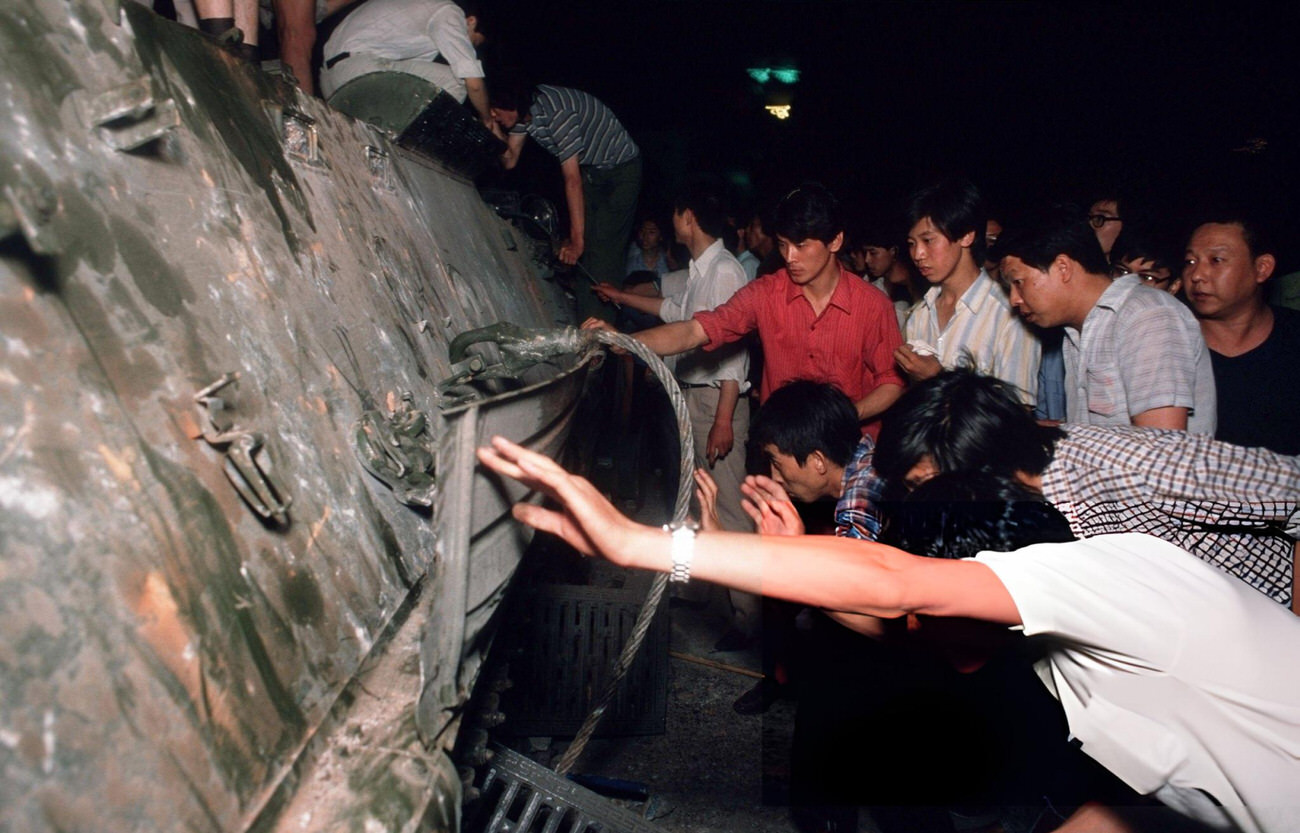
Under harsh night lighting, a crowd of pro-democracy demonstrators presses in close to an armored personnel carrier, hands reaching toward its scarred metal skin. The vehicle dominates the frame at an angle, its hatches, cables, and grime made suddenly intimate by the proximity of civilians who refuse to keep their distance. Faces turn inward with the concentration of inspection—part caution, part curiosity—as if reading the machine for clues about the power it represents.
What stands out is the uneasy choreography between people and armor: some climb and lean over the top while others crouch at the side, peering into seams and fittings. A man in a bright shirt extends an arm across the hull, testing a strap or wire; nearby, onlookers watch with tense, narrowed eyes, trying to understand what has happened and what might come next. The scene feels suspended between confrontation and aftermath, a moment when the street briefly becomes a civic arena.
Set in 1989, the photograph evokes a year when popular movements and state force collided in public spaces across the world, turning everyday city streets into contested ground. For readers searching civil wars history, protest movements, or the visual record of democratization struggles, this image offers a stark study in scale: unarmed bodies against armored steel, human attention against mechanized intimidation. It invites reflection on how revolutions are not only shouted and marched, but also examined up close—touching the symbols of authority to measure their limits.